Salary by segment — the part most websites hide
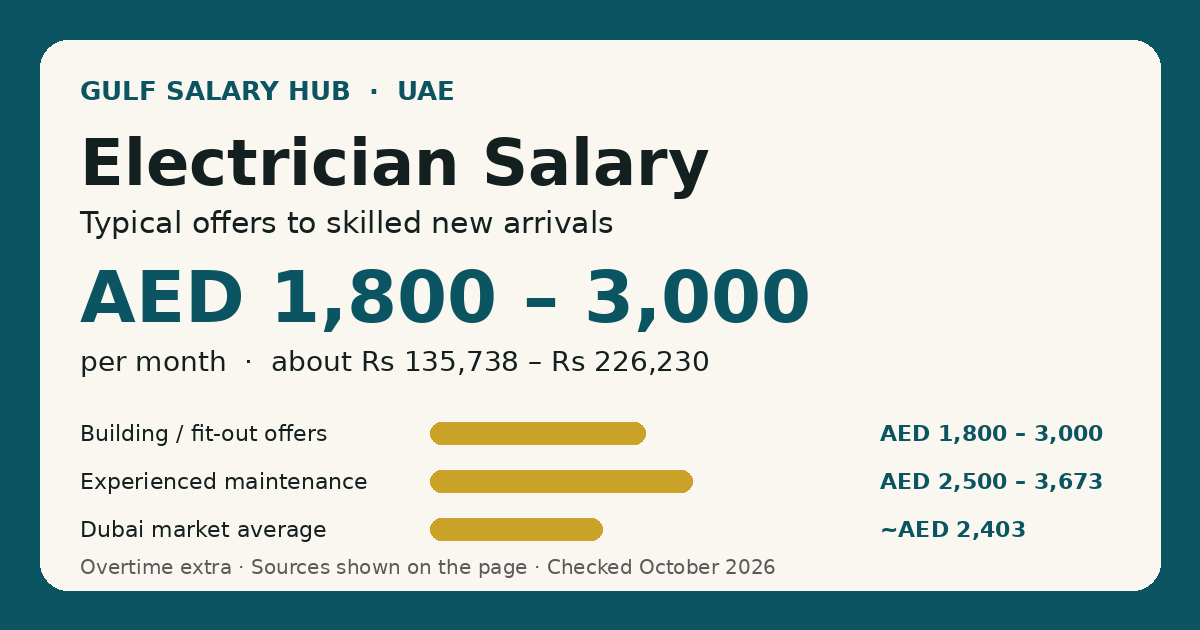
A single "average salary" for this job would mislead you. What you are actually offered depends mostly on the kind of electrical work you can do — building wiring and fit-out work sits in one band, maintenance and fault-finding work in a higher one — and on whether you can pass the employer's practical trade test and read drawings. Overtime is NOT included in any figure on this page — it is variable, so treat it as extra:
| Segment | Monthly salary | Note |
|---|---|---|
| New arrival — building, construction and fit-out electrician offers | AED 1,800 – 3,000 / month | Documented in current advertisements reviewed Oct 2026: a commercial fit-out electrician listing at AED 1,500–3,000 (2+ years, ITI or diploma preferred, sub-distribution-board and lighting work), a Dubai urgent-hiring electrician listing at AED 2,000–3,500 with visa, accommodation and medical insurance provided, and a facilities demand for an electrical technician at AED 1,800 plus a food allowance, with accommodation, transport and medical cover provided. The headline band is where those skilled offers overlap |
| Experienced maintenance and facilities electrician offers | AED 2,500 – 3,673 / month | Documented in current advertisements reviewed Oct 2026: a Bayt residential-maintenance electrician role in Dubai listed at AED 1,836–3,673 for 5–10 years of experience, with free accommodation, transport, visa and health insurance — the top of that range is for experienced maintenance work, not a first offer. Indeed also puts its Senior Electrician average in Dubai at about AED 3,315 a month, inside this segment |
| Market figure, all experience levels | ~AED 2,403 / month average in Dubai (reported range AED 1,169 – 4,937) | Indeed UAE reported salaries for Electrician in Dubai, based on 927 salaries, updated 12 October 2026 — includes junior electricians, experienced maintenance staff and premium locations, so it is context only and not a first offer; its Junior Electrician average is about AED 2,327 a month |
What the job involves
Installing and repairing wiring, lighting, switches, sockets, distribution boards and sub-distribution boards in buildings, shops, villas and sites; running cables neatly in ceilings, risers and containment and terminating and labelling circuits at the board; reading lighting layouts and small-power drawings; testing and inspecting circuits before handover; finding and fixing faults in existing installations, including motors and control panels on maintenance work; isolating supplies safely when working in live or occupied buildings; and following UAE safety rules and the local authority requirements that apply to the work. Fit-out electricians work to opening dates alongside other trades, maintenance electricians work to call-outs and planned servicing — the branch you are hired into decides both your day and your pay.
What your total package usually includes
For electricians in the UAE, the package usually comes down to accommodation, site transport and overtime — a Dubai salary without a room provided is worth far less than the same figure with one:
| Part of the package | What it usually means in practice |
|---|---|
| Housing | Shared accommodation is standard at entry level. Some employers give a housing allowance instead — a room and cash are not worth the same, so ask which one your offer includes. |
| Transport | Company transport to the site is common on project work. City jobs may give a transport allowance, or nothing at all — and if it is nothing, that cost comes out of your salary. |
| Overtime | Paid on top of basic when hours run long. Get the rate — and how the hours are counted — in writing. "Overtime available" with no rate attached means very little. |
| Medical | Employer-provided health insurance, arranged as part of the job. You should receive the insurance card — not have to chase anyone for it. |
| Air ticket | A return ticket home every 1–2 years is standard in most contracts. Check the interval, and whether it covers family (at this level, it usually covers you only). |
Count these before you judge any offer. A slightly lower salary with housing, transport and overtime paid can leave you with more in savings at month's end than a higher headline figure without them.
On a UAE electrician offer, confirm in writing: accommodation provided or an allowance, who provides transport to site, how overtime and call-outs are counted and paid, and whether tools are the employer's cost — those answers are worth more than a small difference in the basic figure.
How pay is structured for electricians in the UAE
Electricians in the UAE are paid a fixed monthly salary, with overtime on top when handovers, fit-out deadlines or breakdown work stretch the day — get the overtime rate into the contract, because a busy month is not the salary. Facilities and maintenance employers sometimes add call-out arrangements for after-hours repairs; those are only worth counting when they are written down. Judge every offer on its written basic and allowances first, and across a full year.
Where electrician jobs are concentrated in the UAE
Dubai holds most of the work — construction and fit-out projects, malls, hotels, residential maintenance and facilities contracts across the city. Abu Dhabi follows with government, industrial and facilities demand, including energy-sector maintenance, and Sharjah adds industrial and residential work. Facilities-management companies are the steadiest year-round employers; installation and fit-out hiring follows the construction cycle.
How to get this job safely
1. Apply to the company directly, or go through a licensed Overseas Employment Promoter — nobody else. 2. Before you pay a single rupee, verify the agent's licence and check the job has a Permission Tracking Number (the guide below shows how). 3. Get the salary, the overtime rate and the accommodation written into the contract — a verbal promise made in an agent's office tends to disappear at the airport. 4. Never hand your original passport to an unlicensed person, and never travel for work without the Protector stamp.
Frequently asked questions
Why do some websites say UAE electricians earn AED 5,000 or more?
Those figures usually describe electrical foremen and supervisors, senior or master electricians, high-voltage specialists, or modelled averages that mix every level together. Indeed puts its Master Electrician average in Dubai far above the general trade, at about AED 8,078 a month — that is a specialist figure, not a general electrician offer. Current advertisements for skilled new arrivals cluster around AED 1,800–3,000, with experienced maintenance electricians up to about AED 3,673 in the Bayt listing we reviewed.
Is overtime included in these salary figures?
No. The figures here are the advertised monthly salary. Site handovers, fit-out deadlines and breakdown call-outs can bring regular overtime — but overtime depends on the employer and the month, so judge an offer on its written salary first, treat overtime as extra, and get its rate in writing.
Is accommodation included for electricians in the UAE?
Often, yes — the current advertisements we reviewed listed company accommodation in several offers, and some also listed transport, visa and health insurance. Where housing is not provided, a Dubai bedspace can take a large share of an electrician salary, so an offer with accommodation can be worth more than a slightly higher salary without it. Check exactly which parts your own offer includes.
How can I get a better electrician salary in the UAE?
Prove the skills employers test for: neat fit-out wiring and finishing, distribution-board work, circuit testing and fault-finding, and the ability to read drawings without constant supervision. An ITI or diploma certificate helps, Gulf experience raises the next offer, and maintenance and panel work pays above basic site wiring. A DEWA or other local-authority competency approval is an advantage where an employer requires it — ask the employer whether they arrange it after arrival.