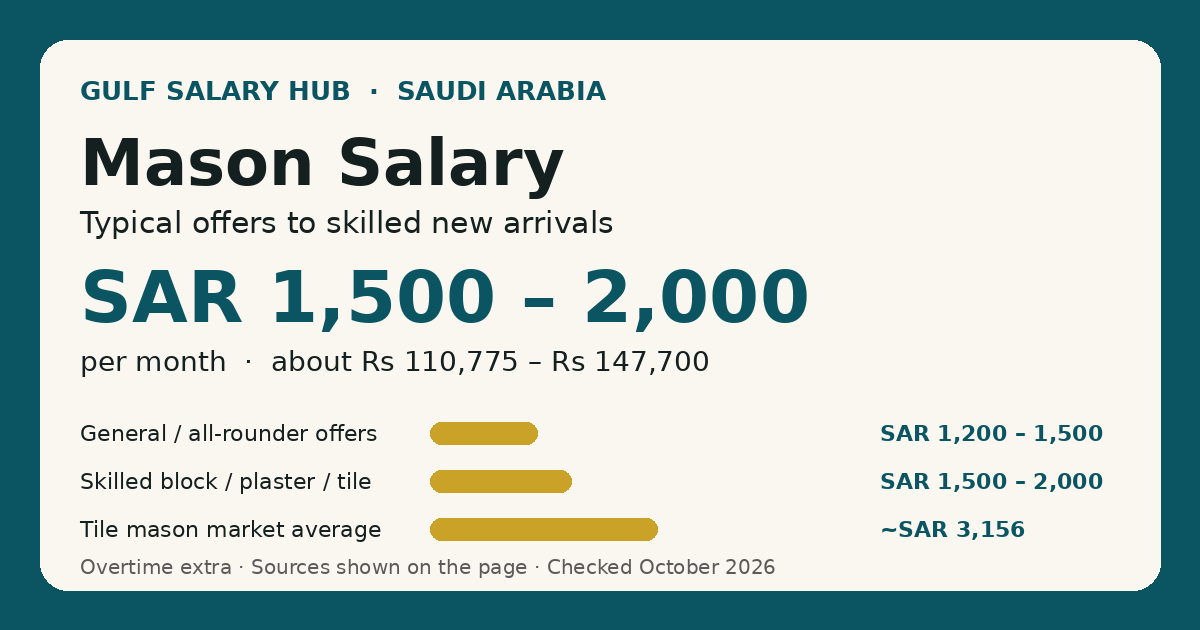
Salary by segment — the part most websites hide
A single "average salary" for this job would mislead you. What you are actually offered depends mostly on the masonry work you can do — general block work, plaster work, or tile and marble fixing, which pays the most — and on whether you can pass the employer's practical trade test. A helper who carries blocks is not paid as a mason, so the segments below separate the grades honestly:
| Segment | Monthly salary | Note |
|---|---|---|
| New arrival — general and all-rounder mason offers | SAR 1,200 – 1,500 / month | Documented in current advertisements reviewed Oct 2026: a general all-rounder mason at SAR 1,200–1,400 with accommodation provided, tile mason offers at SAR 1,300–1,500, and a large contracting company listing tile, block and plaster masons all at SAR 1,500 plus overtime, 10-hour duty, accommodation provided |
| Skilled mason offers — block, plaster and tile, trade-tested and experienced | SAR 1,500 – 2,000 / month | Documented in current advertisements reviewed Oct 2026: the contracting-company mason rate sits at SAR 1,500, and an experienced general mason offer (5–10 years) is advertised at SAR 2,000 with accommodation, food and transport provided — the top of this band needs a passed trade test and proven site experience, not just years claimed on a CV |
| Market figure, all experience levels — tile masons | ~SAR 3,156 / month average (reported range SAR 2,000 – 5,600) | Naukrigulf reported tile mason salaries in Saudi Arabia, based on 38 salaries — includes experienced tile and marble fixers, chargehands and direct-project staff; do not expect this as a first offer |
What the job involves
Laying concrete blocks and bricks with mortar to build walls and partitions, to line and level; plastering walls and ceilings smooth and ready for paint; fixing ceramic, porcelain and marble tiles on floors and walls, including cutting, levelling and grouting; mixing mortar and plaster to the right consistency; reading basic drawings and setting out from string lines and levels; and repairing damaged masonry. Tile and marble fixing is the best-paid branch of the trade, block and plaster work is the volume work on large projects, and every grade is expected to work safely at height and in Gulf heat.
What your total package usually includes
The basic salary is only part of what a Gulf job is worth. Most offers at this level carry some of the following as well — and this is where two offers with the same salary quietly stop being equal:
| Part of the package | What it usually means in practice |
|---|---|
| Housing | Shared accommodation is standard at entry level. Some employers give a housing allowance instead — a room and cash are not worth the same, so ask which one your offer includes. |
| Transport | Company transport to the site is common on project work. City jobs may give a transport allowance, or nothing at all — and if it is nothing, that cost comes out of your salary. |
| Overtime | Paid on top of basic when hours run long. Get the rate — and how the hours are counted — in writing. "Overtime available" with no rate attached means very little. |
| Medical | Employer-provided health insurance, arranged as part of the job. You should receive the insurance card — not have to chase anyone for it. |
| Air ticket | A return ticket home every 1–2 years is standard in most contracts. Check the interval, and whether it covers family (at this level, it usually covers you only). |
Count these before you judge any offer. A slightly lower salary with housing, transport and overtime paid can leave you with more in savings at month's end than a higher headline figure without them.
How to get this job safely
1. Apply to the company directly, or go through a licensed Overseas Employment Promoter — nobody else. 2. Before you pay a single rupee, verify the agent's licence and check the job has a Permission Tracking Number (the guide below shows how). 3. Get the salary, the overtime rate and the accommodation written into the contract — a verbal promise made in an agent's office tends to disappear at the airport. 4. Never hand your original passport to an unlicensed person, and never travel for work without the Protector stamp.
Frequently asked questions
Why do some websites say Saudi masons earn SAR 3,000 or more?
Those figures usually describe the reported average for experienced tile masons — Naukrigulf puts that average at about SAR 3,156 from 38 salaries, with a reported range up to SAR 5,600 — or chargehands and foremen, or modelled averages that mix every level together. Current advertisements for new arrivals cluster around SAR 1,500–2,000 for skilled masons. An experienced tile fixer can earn well above that — but planning your first contract on a specialist average is how workers get disappointed.
Is overtime included in these salary figures?
No. The figures here are the advertised monthly salary. The contracting-company listing we reviewed paid overtime on top of its SAR 1,500 mason rate, and busy projects run long hours — but overtime depends on the project and the month, so judge an offer on its written salary first and treat overtime as extra, and get its rate in writing.
Is accommodation included for masons in Saudi Arabia?
Often, yes on project work — the advertisements we reviewed included company accommodation, and several also included transport, with food provided in some offers and not in others. Camp living is standard on large projects. Check exactly which parts your own offer includes, because food alone can take a noticeable share of a mason salary when it is not provided.
How can I get a better mason salary in Saudi Arabia?
Pass the trade test well — it is practical, and your grade from it sets your rate. Tile and marble fixing pays more than general block work, plastering speed with a clean finish is what supervisors notice, and Gulf project experience raises offers at the next contract. A mason who can set out from drawings and work without constant supervision is on the path to chargehand, where the pay steps up again.