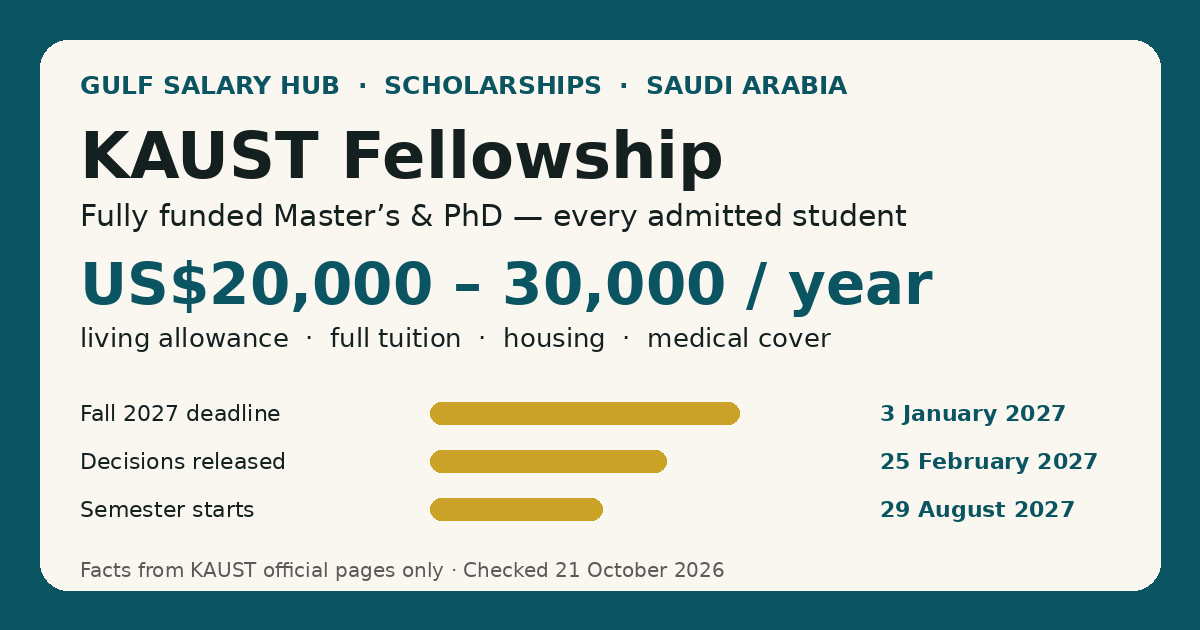
The key point: there is no separate scholarship application
Most fully funded routes make you win admission first and then compete again for funding. KAUST works the other way round. In the university's own words on its Applying page, all admitted students receive the benefits of the KAUST Fellowship, which supports them for the duration of their graduate studies. You submit one application — for admission to a Master's (MS), MS/PhD or PhD programme at King Abdullah University of Science and Technology in Thuwal, Saudi Arabia — and if you are admitted, the fellowship is part of the offer. That single fact is also your best scam protection: because no separate fellowship exists to apply for, nobody can sell you access to one.
What the fellowship covers
| Benefit | What KAUST states |
|---|---|
| Tuition | Full tuition support for the duration of the graduate programme |
| Living allowance | Monthly living allowance of US$20,000–30,000 per year, depending on qualifications and progression through the degree programme |
| Housing | Housing provided (charges may apply for dependent housing) |
| Medical & dental | Medical and dental coverage (charges may apply for dependent coverage) |
| Relocation | Relocation support for the move to KAUST |
Read the allowance figure carefully: it is an annual range, not a monthly one, and where you sit inside it depends on your qualifications and how you progress through the programme. The honest comparison is with other fully funded graduate offers — full tuition plus a five-figure annual allowance, housing and health cover, with no separate funding competition, is a package very few universities anywhere match.
Fall 2027 dates — from KAUST's official timeline
| Stage | Date |
|---|---|
| Round 2 applications opened | 28 September 2026 |
| Application deadline | 3 January 2027 |
| Decisions released | 25 February 2027 |
| Fall semester starts | 29 August 2027 |
Fall 2027 admission is open to MS, MS/PhD and PhD applicants. KAUST marks these dates as tentative and says they may change with application volume — check the official timeline page again before the deadline rather than trusting any summary, including this one. A warning worth repeating: some third-party scholarship blogs circulate a different, earlier February decision date for this round. That date does not appear on KAUST's timeline — the official page says 25 February 2027 — so plan around the official date only.
Spring 2027 — PhD only, and its deadline has passed
Spring 2027 admission is open to PhD applicants only; Master's applicants cannot use that intake. Its Round 1 deadline was 27 September 2026, decisions are released on 19 November 2026, and the Spring semester starts on 17 January 2027. If you want a Master's place, Fall 2027 above is your route.
What you need to apply
English test. A minimum TOEFL iBT score of 81 or an IELTS score of 6.5. Only official scores are accepted (KAUST admissions code 4107), and scores from tests run by an institution for its own admission do not count. No test is required if your degree is from an accredited institution in the United States, Canada, the United Kingdom, Ireland, Australia or New Zealand.
Transcripts. An official, complete transcript, mark sheets, graduation certificate and academic record from every institution you have attended — a scan in the native language uploaded with a certified English translation, including the university grading scale. If you are offered a place, an official final transcript must be sent to the Office of Admissions in a sealed envelope before arrival.
Recommendations. Three letters of recommendation, submitted through the application directly by your recommenders — ideally professors or advisors under whom you did research or took courses in your major field. KAUST asks recommenders to say how they know your work, with comparative statements and insight into your research ability, so choose people who can write specifically, not famous names who barely know you.
CV. A current curriculum vitae is part of the application.
GRE. Not required. KAUST strongly encourages the GRE general test anyway, because a high quantitative score can strengthen an application. Official results go directly from ETS (KAUST code 4139). Treat it as an optional way to strengthen a borderline file, not a barrier.
How to apply — the only route
1. Choose your programme on KAUST's official admissions site and read its timeline page, so your deadline is the university's, not a blog's. 2. Prepare the documents above early — transcripts with certified translations and three committed recommenders take longer than the form itself. 3. Submit through the official admissions portal at admissions.kaust.edu.sa before 3 January 2027, and respond quickly to any interview invitation — KAUST itself advises this to receive a prompt decision. 4. Wait for the official decision, released on 25 February 2027 — if you are admitted, the fellowship terms come with your offer.
Official sources for this guide
Every fact above comes from KAUST's own pages, checked on 21 October 2026: the admissions timeline at admissions.kaust.edu.sa/how-to-apply/admission-timelines (Fall and Spring dates, programme eligibility, tentative-dates note) and the Applying page at kaust.edu.sa/en/study/applying-to-kaust (fellowship benefits, English requirements, transcripts, recommendations, CV and GRE). Nothing on this page comes from a scholarship aggregator. If KAUST changes a date or a requirement, its pages override this guide — tell us via the contact page and we will update it.
Frequently asked questions
Is there a separate application for the KAUST Fellowship?
No. On KAUST's own Applying page, all admitted students receive the benefits of the KAUST Fellowship for the duration of their graduate studies — the funding comes with admission, so you apply once, for admission, through the official admissions portal.
What does the KAUST Fellowship cover?
Full tuition support, a monthly living allowance of US$20,000–30,000 per year depending on qualifications and progression through the degree programme, housing, medical and dental coverage, and relocation support. KAUST notes that charges may apply for dependent housing and medical and dental coverage.
What is the deadline for Fall 2027 entry?
The Round 2 application deadline for Fall 2027 is 3 January 2027. Applications opened on 28 September 2026, decisions are released on 25 February 2027, and the Fall semester starts on 29 August 2027. KAUST marks these dates as tentative, so confirm them on the official timeline page before you rely on them.
Do I need the GRE for KAUST?
No — KAUST does not require the GRE. It strongly encourages applicants to take the GRE general test, because a high quantitative score can strengthen an application. Official scores are sent directly from ETS using KAUST's admissions code 4139.
Can Master's students apply for Spring 2027 entry?
No. KAUST's timeline states that Spring 2027 admission is open to PhD applicants only, and its Round 1 deadline (27 September 2026) has passed. Master's and MS/PhD applicants should apply for Fall 2027, which is open to MS, MS/PhD and PhD applicants.
What English score does KAUST require?
A minimum TOEFL iBT score of 81 or an IELTS score of 6.5, with official scores only (KAUST admissions code 4107). The test is not required if you received your degree from an accredited institution in the United States, Canada, the United Kingdom, Ireland, Australia or New Zealand.