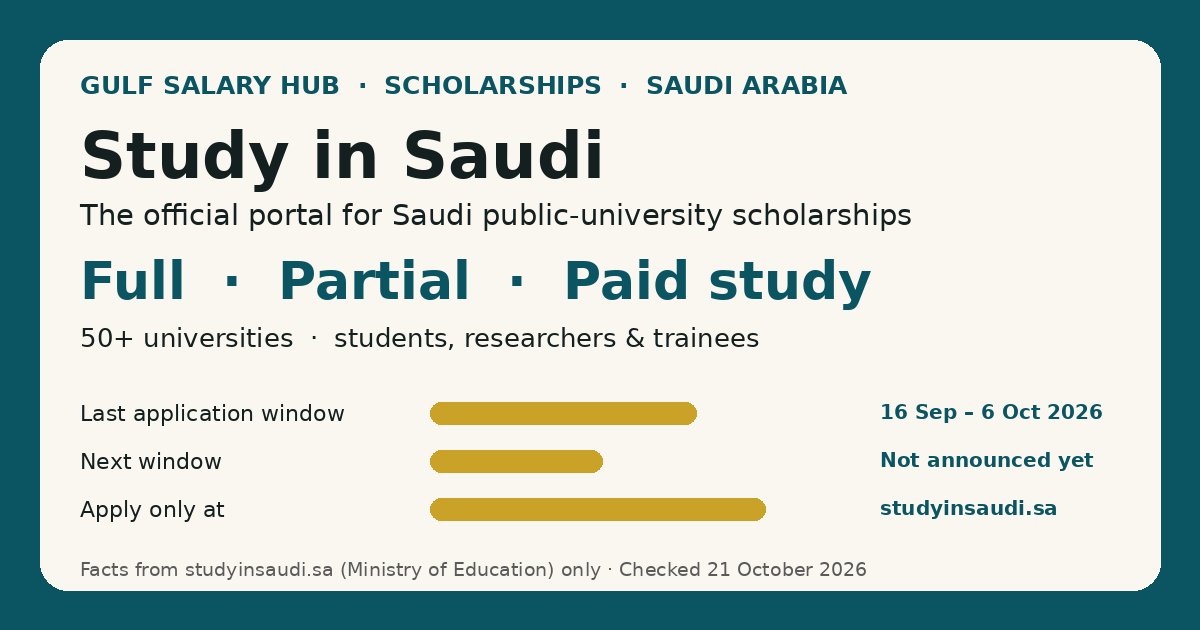
The honest headline first: the window has closed
| Stage | What the official platform says |
|---|---|
| Application period opened (international & resident students) | 16 September 2026 |
| Application period closed | 6 October 2026 |
| Next application window | Not announced yet |
Those dates come from the platform's own timeline, headed “Second Semester Academic Calendar 2026”, checked on 21 October 2026. You will find scholarship blogs announcing a later October deadline for this cycle. That date does not appear anywhere on the official platform — the platform publishes no other 2026–2027 cycle dates — so do not plan around it, and never pay anyone who quotes it to you. When a new window is announced, it will appear on studyinsaudi.sa first. Everything below is written so you can prepare now and apply in days, not weeks, when it does.
What Study in Saudi actually is
Study in Saudi is the Saudi Ministry of Education's single official platform for international study in the Kingdom. Saudi Arabia has more than 50 public and private universities, many of them placed in recognised global rankings such as Times Higher Education, and the platform is the front door to them for students, researchers and trainees. It sits behind the Kingdom's education visa, which exists for exactly those three groups: students in study programmes, researchers, and trainees on professional programmes. You apply through the platform, or by applying for admission to the institution itself — there is no third route, and nobody outside those two channels can put you inside the system.
Three funding routes — read them carefully
| Route | What the platform states |
|---|---|
| Full scholarship | A fully funded educational grant for study at a Saudi university, across a range of specialisations |
| Partial scholarship | A grant that covers part of the study costs, with varied study opportunities for international students |
| Paid study | Enrolment at a Saudi university on a fee-paying programme |
One caution that will save you real disappointment: the word “full” does not come with one identical package at every university. What a specific scholarship covers is set by that university and its regulations, programme by programme. When the window opens, read the funding details on your chosen programme's own page on the platform and judge the offer on what is written there — not on what a blog, a video or an agent says a Saudi scholarship “usually” includes. If you are aiming at a research Master's or PhD with a single published package instead, our KAUST Fellowship guide covers the one programme where the funding terms are stated in full by the university itself.
Who can apply — the platform's own requirements
The platform's FAQ states the study requirements plainly:
Age. You must be 16 or older. The FAQ states no maximum age — but a university or programme can add its own admission conditions, so check the programme page as well.
Passport. A valid passport. For the education visa, it must have at least six months of validity remaining.
Health. A medical report proving freedom from infectious diseases.
Documents. Attested certificates and the required documents, as your chosen institution specifies. Attestation takes time in most countries — this is the single best thing to finish while the window is closed.
One scholarship per degree. A student cannot hold two scholarships for the same academic degree — the platform will block a second application on that ground.
The education visa, briefly
Admission and the visa are two separate steps, and the platform's FAQ lists the visa requirements for both the long-term visa (degree study) and the short-term visa (short programmes). Both ask for: age 16 or older; a passport with at least six months of validity; admission from a licensed and accredited educational institution in the Kingdom; and proof of financial ability to cover study and living costs, or a financial guarantee. Applicants under 18 also need guardian consent and medical approval arrangements for the visa holder and any companions. In plain terms: no admission letter from a real, licensed university means no education visa, whatever anyone promises you.
How an application actually moves
1. You apply — through the platform at studyinsaudi.sa, signing in and submitting your study application to the institution you have chosen. The scholarship itself comes through that institution: the FAQ is explicit that you get a scholarship by submitting a study application to the institution where you wish to study, and the institution reviews it and issues the admission decision.
2. The institution reviews it. Your submitted application is forwarded to the educational institution you selected. While it sits there, your status shows as “Under Process” — the platform's term for an application currently under review under the approved procedures. You track it on the platform until a final acceptance or rejection is issued.
3. The Ministry completes it. Once the institution approves, the institution and the Ministry of Education complete the final admission procedures together and the final decision is issued. A rejection, the FAQ says, means one or more of the admission requirements for that programme or institution were not met — it is a requirements decision, not something an agent can “fix” for a fee.
Prepare now: the checklist that decides who gets in
Windows on this platform are short — the last one ran for three weeks. The applicants who make it are the ones whose paperwork was already done. Use the closed months for this:
Passport first. Check the validity now. If it will have under six months left when a window opens, renew it before anything else.
Attest your certificates. Get your academic certificates and transcripts attested in the form Saudi institutions ask for. This is slow, paper-based and entirely within your control — start it today.
Get the medical report format right. The requirement is a medical report proving freedom from infectious diseases. Do not buy a report from anyone selling “guaranteed” medicals — use a recognised medical centre, as you would for the work-visa medical.
Choose your institutions before the window. Browse the platform's university list while there is no time pressure, shortlist programmes you genuinely qualify for, and read each one's own admission conditions. Applying to a programme whose requirements you do not meet is the stated reason applications get rejected.
Write your data once, correctly. This matters more than people expect — see the next section.
The rules that catch people out
After submission, most of your application is locked. Contact information can be updated at any time, but other application data cannot be modified after submission. Qualification data and certain specified fields can be updated; basic data — your residency, passport or Gulf ID number, gender and nationality — cannot.
Your passport number locks with your first application. You can update it only while your account is new and you have never applied to a programme. Enter it exactly as printed, first time.
Cancellation is narrow. You may cancel a study application only if the institution has not yet taken any action on it.
Your registered email is fixed if you registered with an email address (students resident in the Kingdom can update theirs through their profile). Register with an email you will still control next year.
Official sources for this guide
Every fact above comes from the official Study in Saudi platform, checked on 21 October 2026: the homepage at studyinsaudi.sa/en (the Second Semester 2026 timeline, the 50+ universities, the education-visa audience) and the platform's FAQ at studyinsaudi.sa/en/Faq (study requirements, education-visa requirements, how a scholarship is obtained, application stages, and the edit and cancellation rules). The funding-route descriptions are the platform's own. Nothing on this page comes from a scholarship aggregator, and no deadline appears here that the platform itself does not publish. If the platform announces a new window, its pages override this guide — tell us via the contact page and we will update it.
Frequently asked questions
Are applications open on Study in Saudi right now?
No. The platform's own timeline for the Second Semester Academic Calendar 2026 shows the application period for international and resident students ran from 16 September to 6 October 2026, and that window has closed. No new application window had been announced on the official platform when this guide was checked on 21 October 2026.
I read on a blog that the deadline is the end of October. Is that right?
That date does not appear on the official platform. Study in Saudi publishes its timeline on studyinsaudi.sa, and the only application period it lists for this cycle is 16 September to 6 October 2026. If a blog gives you a deadline the platform itself does not publish, treat the blog — not the platform — as wrong, and never pay anyone on the strength of it.
What is the difference between a full scholarship, a partial scholarship and paid study?
The platform lists three routes. A full scholarship is a fully funded educational grant for study at a Saudi university. A partial scholarship covers part of the study costs. Paid study means enrolling on a fee-paying programme. The exact package attached to any specific programme is set by the university and its regulations, so check the programme's own page on the platform rather than assuming every ‘full’ offer contains the same items.
How do I actually get a scholarship through Study in Saudi?
Through the university, not through an agent. The platform's FAQ says you obtain a scholarship through the educational institution where you wish to study, by submitting a study application; the institution reviews it and issues the admission decision. After you submit, your application goes to the institution you chose, and once the institution approves it, the institution and the Ministry of Education complete the final admission procedures.
What do I need before I can apply?
The platform's study requirements are: you must be 16 or older, hold a valid passport, provide a medical report proving freedom from infectious diseases, and provide attested certificates and the documents your chosen institution requires. A student cannot hold two scholarships for the same degree. For the education visa itself, your passport needs at least six months of validity, and you need admission from a licensed, accredited institution plus proof of financial ability or a financial guarantee.
Can I fix a mistake after I submit my application?
Only partly — which is why preparation matters. Contact information can be updated at any time, but other application data cannot be changed after submission. Qualification data and certain specified fields can be updated; basic data such as your passport or ID number, gender and nationality cannot. Your passport number can only be changed while your account is new and you have not yet applied to any programme.
Is there a maximum age for Study in Saudi scholarships?
The platform's FAQ states a minimum — applicants must be 16 or older — and states no maximum age in the study requirements it publishes. Individual universities and programmes can set their own admission conditions on top of the platform rules, so check your chosen programme's requirements on the platform itself.