Which visa do you need?
| Exit re-entry | Final exit | |
|---|---|---|
| Purpose | Holiday, family visit, short trip | Leaving Saudi Arabia permanently |
| Your Iqama | Stays valid; you return to the same sponsor | Cancelled when you leave |
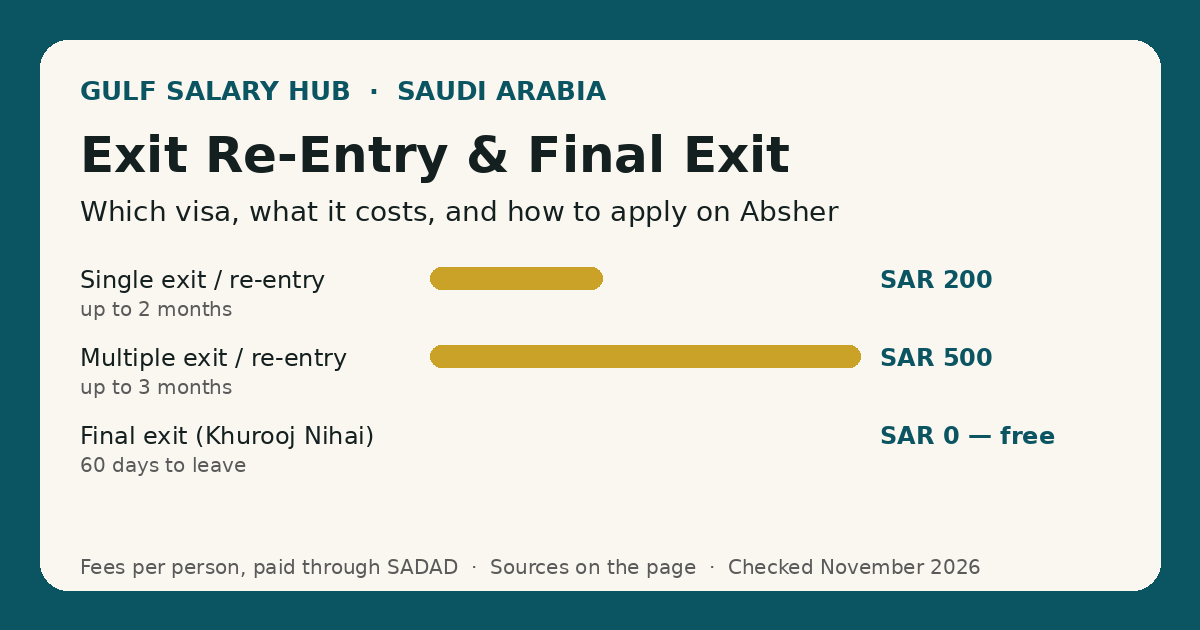
| Fee | Single SAR 200 (up to 2 months); multiple SAR 500 (up to 3 months) | No government fee — SAR 0 |
| Validity | The period you pay for; your Iqama must stay valid throughout | 60 days to leave, capped by your Iqama’s expiry |
| Who issues it | Your employer (Muqeem / Absher Business); you for your dependents (Absher Individuals) | Your employer, or you through Absher once your contract has ended |
| Coming back | On the same Iqama, before the visa expires | Only with a new work or visit visa |
The most expensive mistake on this page is taking a final exit “just to be safe” before a holiday: it cancels your Iqama, and your job goes with it. The second is leaving on an exit re-entry when you are quitting for good: you cannot switch it to a final exit from abroad, and your old employer is left with loose ends. If you have a new Saudi job lined up, neither visa is the route — your new employer transfers your Iqama through Qiwa.
Exit re-entry fees — the full table
| Item | Amount | Notes |
|---|---|---|
| Single exit / re-entry visa (up to 2 months) | SAR 200 | Royal Decree fee, unchanged since January 2023 |
| Single — per additional month (inside Saudi Arabia) | SAR 100 | Per month added at extension time while still inside the Kingdom |
| Single — per additional month (outside Saudi Arabia) | SAR 200 | Extending from abroad costs double the inside-Kingdom rate |
| Multiple exit / re-entry visa (up to 3 months) | SAR 500 | Royal Decree fee, unchanged since January 2023 |
| Multiple — per additional month (inside Saudi Arabia) | SAR 200 | Per month added at extension time while still inside the Kingdom |
| Multiple — per additional month (outside Saudi Arabia) | SAR 400 | Extending from abroad costs double the inside-Kingdom rate |
| Absher processing service fee (extension) | SAR 103.50 | Per extension transaction, since January 2025; a separate line on the SADAD bill |
| Final exit visa — government fee | SAR 0 | Free. Check the SADAD bill line for any processing fee before paying — no figure is confirmed |
Fees are charged per person, including each sponsored dependent, and are non-refundable once the visa is generated in Absher or Muqeem — even if the trip is cancelled. The widely copied claim of a SAR 70 Absher processing fee on final exits could not be verified against Jawazat’s or Absher’s own published fee schedule, so do not budget for a fixed figure: read the SADAD bill line before you pay. And nobody can sell you an exit visa: exit visas are issued only through Absher or Muqeem by your sponsor. Anyone offering to “sell” one is running the same scam pattern our agent-verification guide describes.
How to apply for an exit re-entry visa
1. Check the prerequisites first. Your passport must have at least 90 days of remaining validity, your Iqama must cover the whole trip, all traffic fines must be settled through SADAD, and you must be physically inside the Kingdom when the visa is generated. If your passport expires sooner, renew it and complete the passport transfer (Naql Ma’loomat) in Absher before applying.
2. Choose single or multiple. Your employer issues the visa through Muqeem or Absher Business; for dependents, the head of household issues it through Absher Individuals. Pick single (one trip, up to 2 months, SAR 200 base) or multiple (repeated trips inside the validity, up to 3 months, SAR 500 base), then the start date and duration. The system caps the validity at the shorter of the duration you request or your remaining Iqama validity.
3. Pay through SADAD. Copy the SADAD bill code from the confirmation screen and pay through your bank app. The visa is issued instantly in Absher once the payment posts — download the PDF for travel.
4. Check the status before you fly. Confirm the visa is active in Absher under My Services > Visa Services within 24 hours of flying, and cross-check it on the Muqeem visa-validity portal (vv.muqeem.sa) with your Iqama and passport numbers. Carry the printed PDF and the digital Absher visa on your phone — airport Jawazat checks both, and the boarding pass will be blocked if Jawazat does not see a valid exit.
Extending an exit re-entry visa while you are abroad
If you are already outside Saudi Arabia and need more time before returning, the sponsor can extend the visa electronically before it expires. For family dependents and domestic workers, the head of household does it in Absher Individuals under “Extend Exit and Re-Entry for Sponsorees Outside Kingdom”; for private-sector employees, the employer does it through Absher Business or Muqeem. Two rules decide the cost and the limit. First, the monthly fee doubles abroad: SAR 200 a month for a single visa and SAR 400 a month for a multiple visa, plus the SAR 103.50 Absher processing fee per transaction. Second, your Iqama must have at least 90 days of validity remaining, and your return date must fall at least 7 days before the Iqama expires. Never let the visa expire while abroad without completing the extension — extending inside the Kingdom is half the price, so plan extensions before you fly out if you can.
Final exit — the 60-day window
A final exit visa permanently terminates your residency. Once issued, you have exactly 60 calendar days from the issue date to depart the Kingdom, regardless of the remaining validity printed on your Iqama card — and if your Iqama expires sooner than 60 days, the window is shorter: the visa’s validity is the Iqama’s remaining validity, whichever is shorter. The clock starts at issue, not when you book your flight, so leave a buffer of a week or two for flight changes. To apply, your Iqama must have at least 30 days remaining and your passport at least 60 days. If the 60-day window lapses without departure or cancellation, an automatic SAR 1,000 fine is levied, payable through SADAD before Jawazat will allow the visa to be cancelled or reissued — and the Iqama must still be valid. On cancellation, the guides disagree and the page says so plainly: one guide reports the sponsor can cancel a final exit free of charge within the 60-day window while the worker is still inside the Kingdom with a valid Iqama; another notes Jawazat has not published a clear cancellation process. Treat cancellation as uncertain and confirm with Jawazat before relying on it — do not plan a departure around cancelling a final exit.
Three ways a final exit gets issued
Pathway A — employer-initiated (the standard route). Your employer files through Absher Business when your employment contract has finished. You do nothing on Absher Individuals; HR handles the filing and the visa issues the same day. Most large companies use this route, particularly when the employer also covers your repatriation ticket.
Pathway B — head of household (for dependents). If you are the primary sponsor and want a final exit for a dependent family member, you do it through Absher Individuals under Family Services / Passport Services. This is the route when a spouse travels ahead while you wind down your own contract.
Pathway C — worker self-service (since the 2021 Labour Reform Initiative). Private-sector workers whose contract has ended or expired can apply for their own final exit through Absher Individuals, without waiting for the employer. The employer receives an automated notification and has 10 working days to object on legal grounds only. Silence is treated as approval, and the visa then issues digitally — no physical stamp is needed. This is the route that matters when a worker and employer are in a stalemate over departure. Under the same reforms, workers with authenticated Qiwa contracts can also submit exit/re-entry requests directly through Absher without prior employer approval or paper no-objection certificates; the system notifies the employer electronically, and the worker remains responsible for contractual notice periods and financial commitments.
What blocks a final exit from being issued
The Absher portal does not always explain which blocker is stopping an application — it just rejects it. Clear these before you open Absher:
| Blocker | Where to check | Fix |
|---|---|---|
| Outstanding traffic or municipal fines | Absher fines, MOI portal, SADAD | Pay through SADAD; allow 24–48 hours for the system to clear |
| Active labour dispute | HRSD portal, Qiwa, court system | Weeks to months, depending on the case |
| Vehicle registered in your name | Absher vehicle services | Transfer or sell; 1–5 days |
| Passport validity below 60 days | Your passport book | Renew at your embassy (often weeks), then transfer the details in Absher |
| Iqama validity below 30 days | Absher / Muqeem | Employer must renew the Iqama first |
| Unsettled dependents under your sponsorship | Absher family services | Final exit for each dependent, or a completed sponsorship transfer |
| Unpaid dependent fees | Absher | SAR 400 per dependent per month, any age — a 6-month backlog is SAR 2,400 per person |
Bank loans are not on the standard blocker list, but Saudi banks can file a travel ban (Mana Safar) for unpaid debt — a separate check from the final-exit blockers. Check your travel-ban status on Absher before booking flights, even after the final exit issues. Active Huroob (absent from work) status also blocks the standard final exit pathway: resolve the Huroob first (employer cancellation within the 60-day grace, transfer of sponsorship, or court-ordered cancellation), then apply.
Settle your money before you fly
Getting the final exit visa issued does not mean your financial obligations are settled — and chasing money from abroad is much harder. Saudi labour law entitles you to an end-of-service gratuity if you worked for the same employer for at least two years. Before you leave, confirm in writing: your end-of-service calculation reviewed and agreed with HR (work it out on our gratuity calculator first); your final salary paid up to your last working day; any unused leave paid out; the repatriation air ticket, if your contract includes it; your GOSI (social insurance) record cleared; and an employment certificate issued if you want one for future applications. The cleanest sequence is: settle dues first, then apply for the final exit, then book the flight — in that order. If your employer is delaying the exit visa or withholding end-of-service payments, the self-service route above lets you apply directly, and you can file a complaint through Qiwa before departure: the Ministry can issue enforceable decisions for claims up to SAR 50,000 without involving the court, which is the practical route for most end-of-service disputes.
Can you come back after a final exit?
Yes. A clean final exit carries no automatic re-entry ban — you would need a new work visa or visit visa to return, and your previous Iqama history is visible to the new employer but does not automatically block the application. The old automatic three-year ban for workers whose exit re-entry visa expired while they were abroad no longer applies: Jawazat announced its lifting in January 2024, and guides updated through 2025 and 2026 confirm the position. (The guides date the confirmation differently — the January 2024 announcement against a mid-2025 reform — so treat the lifting itself as settled and the exact date as less certain than the rule.) Re-entry bans still apply for deportation cases (three years to permanent, depending on severity), criminal violations, unresolved Huroob status at departure, and serious labour violations. And one hard limit has not changed: an exit re-entry visa cannot be converted into a final exit while you are outside the Kingdom. If you know you are leaving permanently, apply for the final exit before you leave — do not rely on an exit re-entry permit expiring as a de facto exit strategy.
Frequently asked questions
How much does a single exit re-entry visa cost in Saudi Arabia?
SAR 200 for up to two months, then SAR 100 for each additional month if you extend while still inside the Kingdom. A multiple exit re-entry visa costs SAR 500 for up to three months, then SAR 200 per additional month. Extending from abroad costs double: SAR 200 a month for a single visa and SAR 400 a month for a multiple visa. The fees are per person, including each dependent, and are non-refundable once the visa is generated.
Is a final exit visa really free in Saudi Arabia?
Yes. The final exit visa carries no government fee — SAR 0 — and no confirmed Absher service charge. If a typing centre or PRO helps you with the application, whatever they charge is a private service fee, not a visa cost. Outstanding fines and other blockers must still be cleared before the visa will issue, and those can cost far more than the visa itself.
How long is a final exit visa valid?
A maximum of 60 days from the date it is issued, or until your Iqama expires if that is sooner. If your Iqama has 45 days remaining when the visa is issued, your exit window is 45 days, not 60. The clock starts at issue, not when you book your flight — so leave a buffer of a week or two for flight changes. If the 60-day window lapses without departure or cancellation, an automatic SAR 1,000 fine applies.
Can my employer refuse to issue my final exit visa?
Private-sector workers whose contract has ended or expired can apply for their own final exit through Absher Individuals, without waiting for the employer. The employer then has 10 working days to raise a legal objection; silence is treated as approval. If the employer files objections with no legal basis, escalate to the Ministry of Human Resources and Social Development through Qiwa or the HRSD complaints portal.
Do my dependents need their own exit visas?
Yes. Each dependent needs their own final exit visa, issued by you through Absher Individuals under Family Services, or a completed sponsorship transfer to another sponsor before your final exit will process. Any unpaid dependent fees — SAR 400 per dependent per month, at any age — must be cleared first. A six-month backlog is SAR 2,400 per person.
What happens if my exit re-entry visa expires while I am abroad?
The automatic three-year re-entry ban that used to follow an expired exit re-entry visa no longer applies — Jawazat announced its lifting in January 2024, and guides updated through 2025 and 2026 confirm the position. You can apply for a new work visa and return. But your old residency is forfeit, and you cannot convert an exit re-entry visa into a final exit from abroad — if you are leaving for good, arrange the final exit before you fly out. Bans still apply for deportation, criminal violations, unresolved Huroob status and serious labour violations.
Sources — where these figures were checked
Fees and rules on this page were checked on 20 November 2026 against four current guides, each read in full: (1) Life in Gulf — Saudi Exit Re-Entry & Final Exit Visas: Absher Rules & Fees (last verified 29 October 2026 against the official sources it links); (2) Wathim — Final Exit Visa Saudi Arabia 2026: Rules & Re-Entry (last verified July 2026 against MHRSD and Absher fee schedules); (3) Wathim — Saudi Exit Re-Entry 2026 (last verified June 2026); (4) Saudi Utility Hub — Final Exit vs Exit Re-Entry Visa Saudi Arabia (last reviewed 18 November 2026). Every figure on this page appears in at least two of the four. The authoritative places to confirm your own case are the official portals themselves: Absher (absher.sa), the Ministry of Interior / Jawazat (moi.gov.sa), Qiwa (qiwa.sa) and the Ministry of Human Resources and Social Development (hrsd.gov.sa). Fees are set by Royal Decree and can change — confirm the SADAD bill line before you pay.
Related on this site: the legal Saudi work-visa process from Pakistan, Iqama renewal fees residents actually pay, our end-of-service gratuity calculator for your final settlement, the agent-verification guide before you pay anyone, the Saudi Arabia salary guides that show the real offer ranges behind any job, and the current Gulf job listings — every listing names its source board.