The anatomy — what a package is made of
| Component | What it is | Typical share |
|---|---|---|
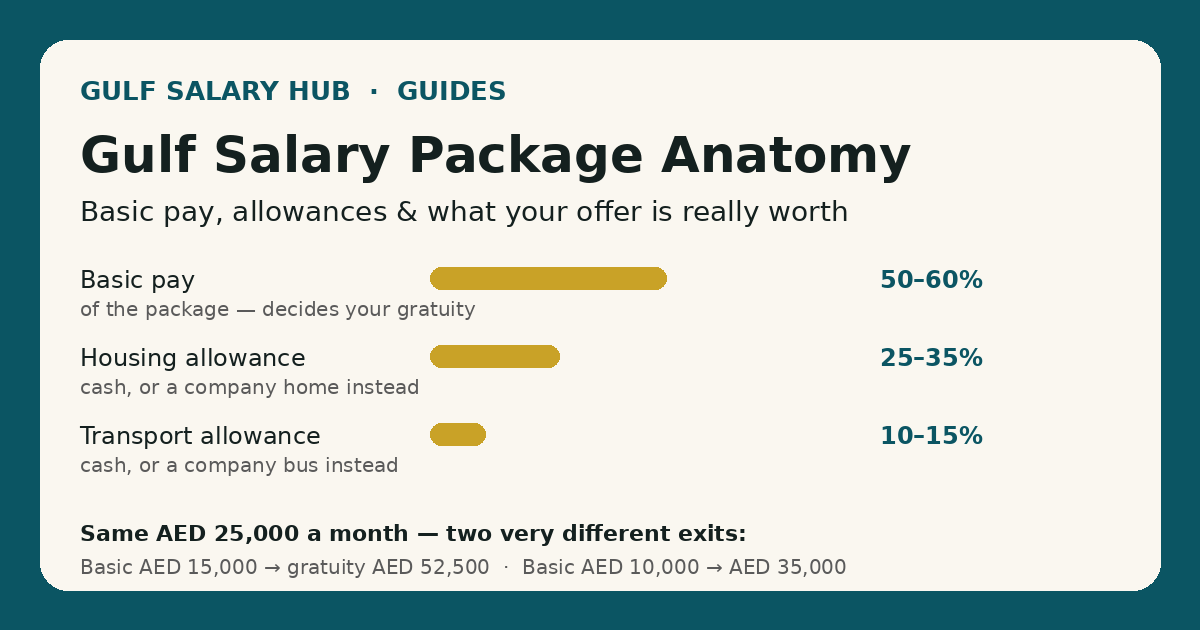
| Basic pay | Fixed monthly cash, the foundation figure of the contract | 50–60% of the package |
| Housing allowance | Cash to rent your own place, or company accommodation instead | 25–35% of the package |
| Transport allowance | Cash for getting to work, or a company bus or car instead | 10–15% of the package |
| Food allowance | Cash for meals, or the company provides food directly | Varies; three provided meals a day is a genuine saving |
| Medical insurance | Cover the employer must provide for you; family cover varies | See below |
| Annual flight ticket | A ticket home once a year, for you — sometimes for family | Common, not statutory in the UAE |
| End-of-service gratuity | Lump sum when you leave, worked out on basic pay only | See the country table below |
Those shares are market habit, not law. No UAE or Saudi law fixes a basic-to-allowance ratio, so the split is negotiable — and the guides quote it two ways: one as a share of the whole package (basic 50–60%, housing 25–35%, transport 10–15%), another as a share of total cash (basic 40–60%) with housing as 25–35% of basic. Both describe the same market. A Bayt.com 2024 MENA salary survey puts housing and transport allowances at an average of 34% of total compensation in the Gulf — the third of the package most candidates ignore when they compare offers.
Why the basic/allowance split matters
Three payments are calculated on basic pay only, so a low basic quietly cuts your future money even when the monthly total looks the same:
1. End-of-service gratuity. In the UAE, Article 51 of Federal Decree-Law No. 33 of 2021 gives 21 days of basic wage for each of the first five years and 30 days a year after that, on the last basic wage, capped at two years of wage. Allowances do not count. Take two AED 25,000-a-month packages (about Rs 1,885,250): Package A splits it as AED 15,000 basic (60%) and Package B as AED 10,000 basic (40%). After five years, Package A pays AED 52,500 in gratuity (15,000 × 21 ÷ 30 × 5, about Rs 3,959,025) and Package B pays AED 35,000 (about Rs 2,639,350). Same monthly pay, AED 17,500 apart at exit. Anything below about 50% basic deserves a question.
2. Overtime and leave cash-out. Your hourly rate — and therefore your overtime — is derived from your basic salary, and unused annual leave paid out at exit is also calculated on basic in the UAE (Cabinet Resolution No. 1 of 2022, Article 19(2)).
3. Job-loss insurance and bank credit. The UAE’s Involuntary Loss of Employment scheme pays 60% of your average basic salary over the last six months, capped at AED 10,000 or AED 20,000 a month by category, for up to three months. Banks also size loans and credit cards mainly on basic salary, so a skewed package can constrain a mortgage application years later.
End-of-service in each country — the three formulas
| UAE | Saudi Arabia | Qatar | |
|---|---|---|---|
| Formula | 21 days of basic wage a year for the first 5 years, 30 days a year after | Half a month of wage a year for the first 5 years, one month a year after | Three weeks (21 days) of basic wage for every year |
| Calculated on | Last basic wage — allowances excluded | Last wage — basic plus fixed allowances normally inside it | Last basic wage — allowances excluded |
| Cap | Two years of wage | None stated | None — no cap |
| If you resign | Full award from one year of service | Reduced: one-third after 2–5 years, two-thirds after 5–10, full after 10 | Full award from one year of service — no resignation reduction |
| Law | Federal Decree-Law No. 33 of 2021, Article 51 | Labour Law, Articles 84–86 | Labour Law No. 14 of 2004, Article 54 |
The Saudi difference is worth understanding: because the award is worked out on the last wage rather than the last basic wage, fixed housing and transport allowances are normally inside it — only variable components such as commissions can be excluded by written agreement (Article 86). That can make a Saudi award worth more per year of service than a UAE gratuity on a low basic, and the reverse is equally possible. A worked example from a large Saudi employer shows the scale: a basic of SAR 18,000 a month (about Rs 1,329,300) with SAR 6,500 housing and SAR 1,500 transport — SAR 26,000 total cash a month (about Rs 1,920,100) — earns SAR 81,000 after seven years (5 × SAR 9,000 + 2 × SAR 18,000, about Rs 5,981,850). In Qatar the rule is the simplest of the three: three weeks of basic wage for every year, part years counted proportionally, with no higher rate after five years and no cap — a QAR 6,000 basic earns QAR 4,200 a year of gratuity. Our UAE gratuity calculator, Qatar gratuity calculator and Saudi end-of-service calculator work all three out from your own figures.
Housing, transport and food — cash or provided?
Company-provided housing. You live in company accommodation — common at large Saudi employers and on site camps. No cash housing allowance, but the market value of equivalent accommodation is often SAR 4,000–8,000 a month. Usually the best deal financially, with geographic constraints.
Cash housing allowance. A fixed monthly sum, or an annual lump sum paid in advance — useful in Dubai, where rent is usually due in one to four large cheques rather than monthly. A housing allowance is only valuable if it covers a meaningful part of your actual rent: in Riyadh in 2024, a decent two-bedroom apartment ran SAR 3,000–5,500 a month depending on the district.
Transport and food. Transport allowance is usually SAR 800–2,000 a month as a fixed cash amount; on remote sites it may be replaced by a company bus, which is worth money if you would otherwise pay for taxis or a car. Food is either a cash allowance or three provided meals a day on a site camp — a genuine saving, because food is a worker’s second-biggest monthly cost after housing.
Neither is the better choice in the abstract: cash gives you choice over where you live and what you eat, which matters most for family life; provided housing, transport and food collapse your monthly costs, which matters most for saving. Compare them by pricing what each is actually worth to you, not by the label.
Medical cover and the annual ticket
Medical cover for the employee is mandatory everywhere in the Gulf and the employer may not pass the premium to you. In the UAE the rules are emirate-level: Dubai’s Law No. 11 of 2013 obliges the employer to enrol and pay for employees; Abu Dhabi’s Law No. 23 of 2005 goes further and obliges the employer to cover the employee’s wife and three children under 18; in Sharjah, Ajman, Umm Al Quwain, Ras Al Khaimah and Fujairah, employers must buy the MoHRE Basic Health Insurance package (AED 320 a year) as a condition of issuing or renewing a residency permit. In Saudi Arabia the employer must insure non-Saudi employees and their resident family members (wife, sons under 25, unmarried daughters) from the day of arrival. Family cover is the item to check: outside Abu Dhabi and Saudi Arabia it is usually the sponsor’s cost unless the employer extends it — a family plan runs AED 10,000–20,000 a year if you pay it yourself.
The annual flight ticket is common practice, not a statutory entitlement in the UAE — the only ticket obligation in the UAE labour law is the employer bearing your repatriation expenses at the end of the contract. In Saudi Arabia the employer’s duty is wider: Article 40 puts recruitment fees, Iqama and work-permit issue and renewal, exit and re-entry visas and the return ticket home at the end of the employment on the employer, and any contract term to the contrary is void. Ask in writing whether the annual ticket covers you only or your family, and whether it is cash or a booked ticket.
The smaller lines that still matter
Education allowance. Not statutory anywhere in the Gulf, and usually capped per child — but at top-tier Saudi employers it averages SAR 40,000–80,000 a year per school-age child (Mercer 2024 MENA survey), so for a family with two children it can be SAR 80,000–160,000 a year of value that never appears in the basic salary figure.
Job-loss insurance (UAE only). The Involuntary Loss of Employment scheme (Federal Decree-Law No. 13 of 2022) pays 60% of your average basic salary over the most recent six months, capped at AED 10,000 a month for Category A (basic AED 16,000 or below) and AED 20,000 for Category B, for up to three consecutive months per claim, after at least 12 consecutive months of premiums (AED 5 or AED 10 a month plus VAT). It is the only payroll deduction an expatriate worker has in the UAE.
Social insurance (Saudi Arabia). Expatriates have nothing deducted: the employer pays 2% of the contributory wage for occupational hazards. The contributory wage is the basic wage plus any cash housing allowance (or two months of basic wage where housing is provided in kind), between a SR 1,500 floor and a SR 45,000 ceiling.
Tax. There is no personal income tax on salaries in the UAE or Saudi Arabia — so gross is close to net for an expatriate. VAT is 5% in the UAE and 15% in Saudi Arabia, which affects what your pay buys rather than what you are paid.
Annual leave and probation. Saudi Arabia’s legal minimum is 21 days of annual leave a year; Qatar gives three weeks a year, rising to four weeks after five years with the same employer. UAE probation is at most six months, with notice after probation of 30 to 90 days. Saudi probation is at most 90 days, extendable by written agreement to 180; notice on an indefinite monthly-paid contract is 30 days from the worker and 60 days from the employer. The law sets the ranges; the contract sets the number inside the range.
The traps
Trap 1: Treating basic salary as the only negotiation lever. Gulf employers are often more flexible on allowances precisely because allowances do not compound into end-of-service obligations. A recruiter who cannot move basic salary by SAR 2,000 may be able to add SAR 1,500 to a housing allowance without escalation — the total cash difference is similar and the end-of-service difference is zero.
Trap 2: The all-inclusive offer with no split. An offer quoted as one flat figure — “SAR 24,000 a month, all-inclusive” — tells you nothing about your gratuity, your overtime rate or your insurance cover. Ask for the basic wage as a separate line in writing before you compare anything else.
Trap 3: The offer letter and the filed contract disagree. In the UAE the MoHRE contract is based on the signed offer letter, and once signed the employer may not alter its provisions without both parties’ consent. In Saudi Arabia the contract is authenticated on Qiwa, and the Qiwa version is the one that counts. Read the filed contract line by line against the offer — the filed version is what a court reads.
Trap 4: An end-of-service clause that is not the law. Some contracts cap end-of-service at a fixed number of months regardless of tenure, or forfeit it if you resign within the first year or during probation. If you plan to stay two to three years at most, that clause changes the value of the whole offer.
Trap 5: The salary-switch on arrival. The promised salary in Pakistan becomes a lower salary in the Gulf, with a new contract to sign on the spot. This is why the written offer and the Qiwa-recorded or MoHRE-recorded contract matter: check the number in the filed contract against the number you signed for, immediately, and object in writing if they differ. Our agent-verification guide covers the five checks to run before you pay anyone anything.
How to compare two offers in 20 minutes
1. Monthly cash: basic + housing + transport + any other fixed allowances. 2. Annual cash value: monthly cash × 12 + expected bonus. 3. Five-year end-of-service: from basic salary only, using the formula for the country in the table above. 4. Non-cash benefit value: medical cover, flight tickets, school fees — at real market values. 5. Cost-of-living adjustment: rent, schooling, family medical and transport can move two identical gross offers apart by more than the salary difference. 6. Disposable after fixed costs: the comparable number — what is left after rent, schooling, medical and transport. The candidate who does this arithmetic has a materially stronger negotiation position than the one who does not.
Eight questions to ask before you sign
1. What is the basic wage, as a separate line? 2. Which allowances are fixed, and which are conditional — is housing cash in hand or “subject to policy”? 3. Who covers medical insurance, and for whom? 4. What are the notice and probation terms, in days? 5. Is there an annual ticket, and for whom? 6. Is the bonus contractual, discretionary or target-linked? 7. Does the written offer match what will be filed with MoHRE or on Qiwa? 8. What is the total cost of living I will actually carry? If you take one thing from this page: ask for the basic wage in writing before you compare anything else.
Frequently asked questions
What does a Gulf salary package include?
Basic pay, housing and transport allowances, and usually food, medical insurance, an annual flight ticket and an end-of-service gratuity. The basic salary is typically 40–60% of total cash — the smallest piece, but the figure your gratuity, overtime and job-loss insurance are calculated on.
Is housing allowance included in gratuity in the UAE?
No. Article 51 of Federal Decree-Law No. 33 of 2021 calculates gratuity on the last basic wage only, which the law defines as excluding allowances and benefits in kind. On two AED 25,000 packages, a AED 15,000 basic earns AED 52,500 after five years and a AED 10,000 basic earns AED 35,000.
Is housing allowance included in end-of-service in Saudi Arabia?
Generally yes. Article 84 works the award out on the last wage, which HRSD describes as the basic wage plus all other due increases under the contract — so fixed housing and transport allowances are normally inside it. Only variable components such as commissions can be excluded by written agreement, under Article 86.
What is a good basic-to-total split?
The common market pattern is 50–60% basic, 25–35% housing and 10–15% transport. Anything below about 50% basic deserves a question, because it quietly cuts your gratuity, overtime and borrowing power. No UAE or Saudi law fixes a ratio, so the split is negotiable.
Does my employer pay my Iqama and visa costs?
In Saudi Arabia, yes — Article 40 puts recruitment fees, Iqama and work-permit issue and renewal, exit and re-entry visas and the final return ticket on the employer, and any term to the contrary is void. In the UAE, Article 6(4) prohibits the employer from charging the worker for recruitment and employment costs.
Is there income tax on a Gulf salary?
No personal income tax on salaries in the UAE or Saudi Arabia. VAT is 5% in the UAE and 15% in Saudi Arabia, which affects what your pay buys rather than what you are paid. Expatriates have no pension deduction in either country — the end-of-service gratuity is the substitute.
Sources — where these figures were checked
Figures and rules on this page were checked on 25 November 2026 against three current guides, each read in full: (1) IntervYou — Gulf Job Offer Explained: Salary, Allowances, and Benefits (updated November 2026); (2) Labeeb — Pay, Packages & Job Offers in the UAE and Saudi Arabia (last verified 25 September 2026, each rule linked to the official text it comes from); (3) GCC Nest — Reading a UAE salary offer: basic, allowances, gratuity and the traps (published 9 June 2026). Qatar’s gratuity rule was checked against Get Qatar Jobs — Gratuity Calculation Qatar 2026 (last reviewed 23 November 2026) and the concordant law-firm guides it agrees with. The official texts behind the rules are the UAE’s Federal Decree-Law No. 33 of 2021 (Articles 1, 6, 13, 43 and 51) and Cabinet Resolution No. 1 of 2022, the Involuntary Loss of Employment scheme under Federal Decree-Law No. 13 of 2022, Saudi Arabia’s Labour Law under Royal Decree No. M/51 as amended by Royal Decree No. M/44 of 2024 (Articles 2, 40, 53, 75 and 84–86), Qatar’s Labour Law No. 14 of 2004 (Article 54), and the GOSI contribution rules. Every figure on this page appears in at least two of the guides, and the one point where the guides quote the split differently — as a share of the package or as a share of total cash — is stated on the page rather than smoothed over.
Related on this site: Saudi Arabia vs UAE for workers — the country-by-country comparison behind the table above; the exit re-entry and final exit guide for what happens when the job ends; the legal Saudi work-visa process from Pakistan; the agent-verification guide before you pay anyone; the salary index with every verified pay range on this site; the salary converter to read any Gulf figure in rupees; and the current Gulf job listings — every listing names its source board.