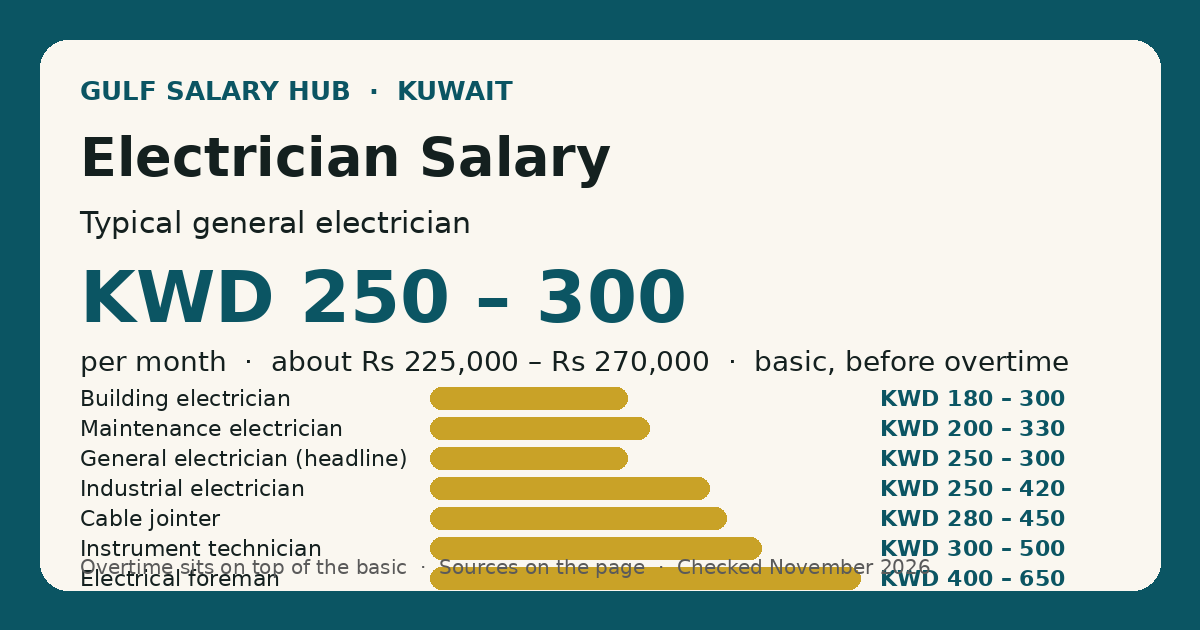
An electrician in Kuwait typically earns KWD 250–300 per month as a general electrician — the band both current guides agree on, as a basic salary before overtime. Building electricians earn KWD 180–300 and maintenance electricians KWD 200–330, while industrial electricians reach KWD 250–420 and electrical foremen KWD 400–650. Expatriates are hired on employer-sponsored work permits through the Public Authority for Manpower.
Salary by segment — the part most websites hide
Read two things first. Electrician work in Kuwait is open to expatriates – both guides reviewed for this page are written for overseas electricians hired on employer-sponsored work permits, and no Kuwaitization reservation for electricians was found in either guide. Second, a single “average salary” for this job would mislead you twice over: Kuwait pays electricians a monthly basic, and the grade – building, maintenance, industrial, cable jointing or instrumentation – decides the band. Overtime is NOT folded into any figure on this page – it is paid at a premium under the private-sector labour law and sits on top of the basic:
| Segment | Monthly salary | Note |
|---|---|---|
| General electrician – the headline band | KWD 250 – 300 / month | Documented in current guides reviewed Nov 2026: this is the overlap both guides agree – the first guide puts Kuwait electricians typically at KWD 250 – 500 a month, and the second guide puts building electricians at KWD 180 – 300, maintenance electricians at KWD 200 – 330 and industrial electricians at KWD 250 – 420. The cross-check guides agree: one puts a general electrician at KWD 180 – 350 and the other puts experienced electricians at KWD 150 – 450+. This is a monthly basic, before overtime |
| Building electrician | KWD 180 – 300 / month | Documented in current guides reviewed Nov 2026: the second guide puts building electricians at KWD 180 – 300 a month – installing conduits, pulling cables, fixing switches and sockets, mounting distribution boards and connecting lighting in villas, apartments, schools and offices, usually in large teams on construction projects. The first rung for a new arrival on building work sits at the bottom of this band |
| Maintenance electrician | KWD 200 – 330 / month | Documented in current guides reviewed Nov 2026: the second guide puts maintenance electricians at KWD 200 – 330 a month – keeping existing buildings running in malls, hospitals, hotels and ministries, responding to tripping breakers, faulty lighting and pump failures. Facility management companies prefer candidates who can work independently and keep proper job records |
| Industrial electrician | KWD 250 – 420 / month | Documented in current guides reviewed Nov 2026: the second guide puts industrial electricians at KWD 250 – 420 a month – motors, starters, variable frequency drives and control panels in factories, refineries and plants – and the first guide puts industrial electricians with safety certifications at the upper end of its KWD 250 – 500 band. Fault-finding under pressure is the core skill, and oil-sector employers often require hazardous-area training |
| Solar PV technician | KWD 220 – 380 / month | Documented in current guides reviewed Nov 2026: the second guide puts solar PV technicians at KWD 220 – 380 a month – installing panels, mounting structures, DC cabling and inverters, then cleaning, testing and repairing systems. Kuwait’s Shagaya renewable energy complex and rooftop solar work are growing, so this is the grade with the most new demand |
| Panel wireman | KWD 180 – 280 / month | Documented in current guides reviewed Nov 2026: the second guide puts panel wiremen at KWD 180 – 280 a month – assembling and wiring switchboards, motor control centres and control panels inside fabrication workshops, following schematic drawings accurately |
| Cable jointer | KWD 280 – 450 / month | Documented in current guides reviewed Nov 2026: the second guide puts cable jointers at KWD 280 – 450 a month – splicing and terminating low and high voltage cables for utilities, substations and large projects. Qualified high-voltage jointers are relatively scarce, which lifts their pay above most other electrical trades |
| Instrument technician | KWD 300 – 500 / month | Documented in current guides reviewed Nov 2026: the second guide puts instrument technicians at KWD 300 – 500 a month – installing and calibrating sensors, transmitters and control loops, mainly in oil, gas and process plants. The role blends electrical skill with process knowledge and usually needs a diploma |
| Electrical foreman | KWD 400 – 650 / month | Documented in current guides reviewed Nov 2026: the second guide puts electrical foremen at KWD 400 – 650 a month – the top grade on this page, leading electrical teams on site. Most employers hire foremen up to around age 50, and the role needs several years of Kuwait or Gulf site experience behind it |
| Assistant electrician | KWD 120 – 180 / month | Cross-check guide only – treat as context, not a confirmed band: the cross-check guide reviewed this run puts assistant electricians at KWD 120 – 180 a month for entry-level electrical work. The two primary guides do not break out a helper grade for Kuwait, so this row is the cross-check figure alone – a first job usually starts here and moves up once you can work independently |
| Modelled salary-survey figure – NOT used as an offer | KWD 455 – 924 / month for the middle 80% (modelled survey) | Paylab’s 2026 Kuwait electrician salary survey puts 80% of electricians between KWD 455 and 924 a month gross – a modelled figure built from survey submissions, above every current guide band on this page except the foreman top. It is not used anywhere on this page – treat any advert quoting it as a different job with a similar name, and get the written basic for your own grade before you believe it |
| Legal minimum wage – a floor, never a first offer | KWD 75 / month | Kuwait’s private-sector minimum wage is KWD 75 a month, set by the Ministry of Social Affairs and Labour in 2017 and still in force in 2026 (stated in the cross-check guide reviewed this run). It is a floor in the law, far below every market band on this page – no electrician offer should be anywhere near it |
What the job involves
Installing conduits, pulling cables, fixing switches and sockets, mounting distribution boards and connecting lighting in villas, apartments, schools and offices; responding to tripping breakers, faulty lighting, pump failures and power issues in malls, hospitals, hotels and ministries, and keeping a proper record of every job; working on motors, starters, variable frequency drives and control panels in factories, refineries and plants, where fault-finding under pressure is the core skill; splicing and terminating low and high voltage cables, and assembling and wiring switchboards and motor control centres from schematic drawings; installing and calibrating sensors, transmitters and control loops in oil, gas and process plants; testing with insulation testers, earth testers, loop impedance and RCD testers, clamp meters, phase rotation meters and thermal cameras, and recording and explaining the results clearly; and following lock-out and tag-out procedures, using insulated tools and arc-rated clothing, and working to British and IEC wiring standards on a 240 volt single phase / 415 volt three phase, 50 hertz supply.
What your total package usually includes
For electricians in Kuwait, the package lines that decide the real offer are the basic grade, accommodation and who pays for specialist certificates – read the table with those in mind:
| Part of the package | What it usually means in practice |
|---|---|
| Housing | Shared accommodation is standard at entry level. Some employers give a housing allowance instead — a room and cash are not worth the same, so ask which one your offer includes. |
| Transport | Company transport to the site is common on project work. City jobs may give a transport allowance, or nothing at all — and if it is nothing, that cost comes out of your salary. |
| Overtime | Paid on top of basic when hours run long. Get the rate — and how the hours are counted — in writing. "Overtime available" with no rate attached means very little. |
| Medical | Employer-provided health insurance, arranged as part of the job. You should receive the insurance card — not have to chase anyone for it. |
| Air ticket | A return ticket home every 1–2 years is standard in most contracts. Check the interval, and whether it covers family (at this level, it usually covers you only). |
Count these before you judge any offer. A slightly lower salary with housing, transport and overtime paid can leave you with more in savings at month's end than a higher headline figure without them.
On a Kuwait electrician offer, confirm in writing: the grade and the basic salary for that grade, whether accommodation and food are provided or an allowance, who pays for specialist certificates such as hazardous-area training, how overtime is calculated and recorded, and which residence the job is on (Article 18 company work) – those answers are worth more than a small difference in the basic figure.
How pay is structured for electricians in Kuwait
Electricians in Kuwait are paid a fixed monthly basic salary in Kuwaiti dinars, with overtime on top at a premium rate under the private-sector labour law – get the overtime rate and how hours are counted into the contract, because the basic, not the overtime, decides your end-of-service indemnity. Kuwait levies no personal income tax on salaries, so the agreed basic is the take-home figure before any deduction the contract itself states. Salaries are paid into a bank account under the Wage Protection System – cash payment is a warning sign, not a convenience. The legal minimum wage of KWD 75 a month is a floor in the law, not a market rate – every band on this page sits well above it. Because the dinar is so strong – one dinar is about Rs 900 – small dinar differences are large money at home: KWD 20 a month is about Rs 18,000, so the provided parts of the package (room, food and transport) deserve the same attention as the salary figure itself.
Where electrician jobs are concentrated in Kuwait
Kuwait City and Salmiya hold most construction and maintenance work – new residential towers, malls, hotels, hospitals and offices. Ahmadi and Fahaheel are where the oil and gas contractor work concentrates – refineries, energy projects and the oil fields, where industrial electricians, cable jointers and instrument technicians earn the most. Farwaniya, Hawally and Jahra add large residential and services demand, Shuwaikh Industrial and Sabhan hold panel workshops and electrical suppliers, and the Shagaya renewable energy complex in the western desert is where solar PV work is growing. Hiring runs year-round, with project peaks driving overtime.
How to get this job safely
1. Apply to the company directly, or go through a licensed Overseas Employment Promoter — nobody else. 2. Before you pay a single rupee, verify the agent's licence and check the job has a Permission Tracking Number (the guide below shows how). 3. Get the salary, the overtime rate and the accommodation written into the contract — a verbal promise made in an agent's office tends to disappear at the airport. 4. Never hand your original passport to an unlicensed person, and never travel for work without the Protector stamp.
Frequently asked questions
Why do some websites say Kuwait electricians earn KWD 900 or more a month?
Those figures come from a modelled salary survey, not from contractor offers. Paylab’s 2026 Kuwait electrician survey puts 80% of electricians between KWD 455 and 924 a month gross – a modelled figure built from survey submissions, with no grade, employer or contract behind it. The two detailed guides reviewed for this page put a general electrician at KWD 250 – 300 a month basic, and the cross-check guides agree, putting a general electrician at KWD 180 – 350. The survey figure is shown on this page only as a warning row. A foreman can reach KWD 650 – but that is the top grade after years of site experience, not a general electrician’s month. Plan your first contract on the band for the grade you are actually hired at.
Can an expatriate work as an electrician in Kuwait?
Yes. Both guides reviewed for this page are written for overseas electricians hired on employer-sponsored work permits – the employer applies to the Public Authority for Manpower before you travel, then arranges the entry visa, medical test, fingerprints and Civil ID after arrival. No Kuwaitization reservation for electricians was found in either guide, and the guides describe Indian, Nepali, Bangladeshi, Sri Lankan, Filipino and Egyptian electricians working in Kuwait. The conditions are practical, not nationality-based: an ITI or technical diploma in electrical work, at least two years of hands-on experience, and a practical trade test before the offer is confirmed. Never pay anyone for a visa: the employer applies for the permit in your name.
What does the package usually include for electricians in Kuwait?
Usually a two-year renewable contract on an employer-sponsored work permit, with free or subsidised shared accommodation, transport to site and medical cover – many private-sector workers receive care through Dhaman, while larger employers run group medical plans – plus a return air ticket and 30 days of paid leave a year. Food is sometimes provided and sometimes not, so check it in writing. Wages are paid into a bank account under the Wage Protection System, and Kuwait levies no income tax on salaries, so the agreed basic is the take-home figure before any deduction the contract itself states. At the end of service, the labour law provides an indemnity based on your final basic salary and total years worked – monthly-paid workers receive at least 15 days of wages for each of the first five years and one month of wages for each year after that. Confirm every part in writing before you judge the figure.
Do I need a licence or certificate to work as an electrician in Kuwait?
You need an ITI, technical diploma or vocational certificate in electrical work plus at least two years of hands-on experience – industrial and high-voltage roles often ask for four or more. Most Kuwaiti employers hold a practical trade test before confirming an offer: wiring a distribution board, connecting a motor starter, identifying faults in a circuit and explaining test results. New electrical connections must pass inspection by the Ministry of Electricity, Water and Renewable Energy before power is supplied, and design and installation on many projects follows British and IEC standards – electricians familiar with BS 7671 wiring practices, cable colour codes, earthing and testing adjust much faster. Oil-sector employers often require additional certificates, such as hazardous-area training under the CompEx scheme. Normal colour vision is essential for identifying cable colours, and is checked in the medical fitness test.
Is overtime included in the salary figures on this page?
No. Every figure on this page is the monthly basic salary, before overtime. Overtime is paid at a premium under the private-sector labour law, and the first guide reviewed for this page says it often adds 20 – 40% to take-home pay – the second guide says the same, that overtime can add a meaningful amount during project deadlines and summer breakdown periods. Kuwait’s summer midday work ban, generally 11 a.m. to 4 p.m. from June to August, protects outdoor crews. Get the overtime rate, how hours are recorded and the typical monthly overtime for your site written into the offer before you sign, because the basic – not the overtime – decides your end-of-service indemnity.
How can I earn more as an electrician in Kuwait?
Specialise and prove it. Both guides agree on the ladder: a building electrician at KWD 180 – 300 moves up by learning industrial work (KWD 250 – 420), then cable jointing (KWD 280 – 450) or instrumentation (KWD 300 – 500), and finally foreman work at KWD 400 – 650. The skills that pay are high-voltage jointing, hazardous-area training for oil and gas sites, controls and automation, and solar PV installation as Kuwait builds renewable capacity. Two or three years of Kuwait experience also lifts your next offer, because local experience is highly valued. Keep a short summary of the major projects you have worked on – hospitals, malls, substations, refineries – because recruiters shortlist on project type. Never pay a recruiter for an electrician job, and never travel on a visit visa to look for work.