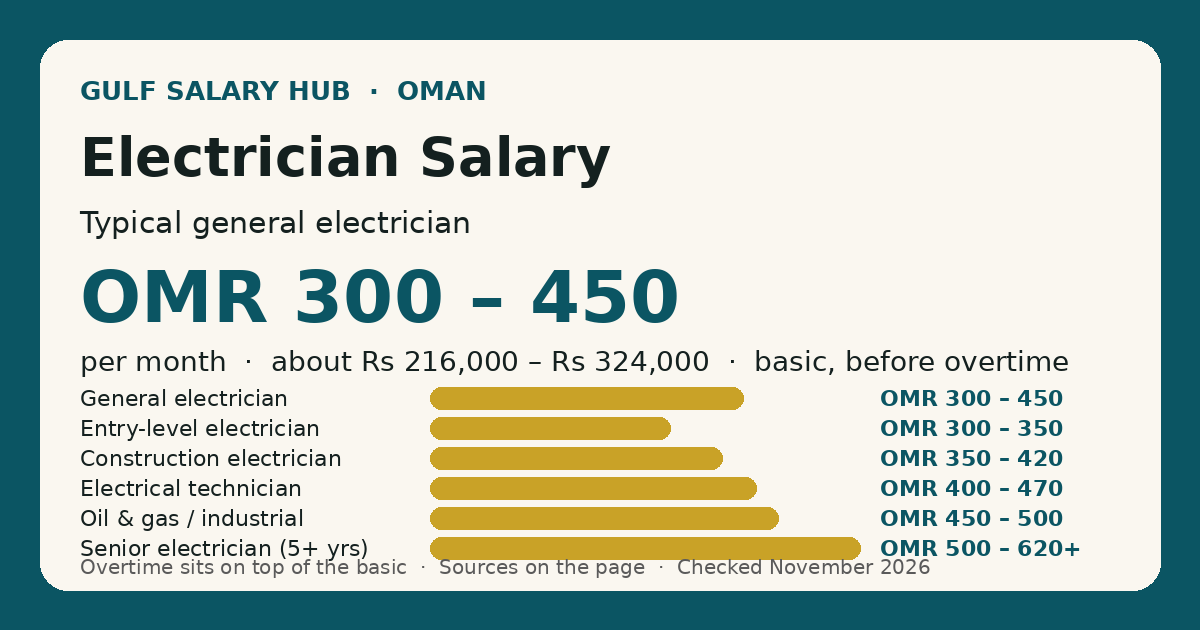
An electrician in Oman typically earns OMR 300–450 per month basic — the band both current guides agree on for a general electrician, before overtime. Entry-level electricians earn OMR 300–350 and senior electricians OMR 500–620 or more. Expatriates are hired on employer-sponsored work permits, subject to Omanisation quotas.
Salary by segment — the part most websites hide
Read two things first. Electrician work in Oman is open to expatriates – both guides reviewed for this page are written for overseas electricians hired on employer-sponsored work permits, and Omanisation works as a workforce quota the employer must meet, not a reservation of the trade. Second, a single “average salary” for this job would mislead you twice over: Oman pays electricians a monthly basic, and the grade – entry-level, construction, technician, industrial or senior – decides the band. Overtime is NOT folded into any figure on this page – it is paid extra and often adds 20–40% to take-home pay:
| Segment | Monthly salary | Note |
|---|---|---|
| General electrician – the headline band | OMR 300 – 450 / month | Documented in current guides reviewed Nov 2026: this is the band both guides agree for a general electrician – the first guide puts Oman electricians typically at OMR 250 – 450 a month, and the second guide puts experienced construction and industrial electricians at OMR 300 – 500. The headline band is where those two ranges overlap, and it matches the second guide’s entry-level and construction grades. This is a monthly basic, before overtime |
| Entry-level electrician | OMR 300 – 350 / month | Documented in current guides reviewed Nov 2026: the second guide puts entry-level electricians at OMR 300 – 350 a month, and its layboard listing data puts entry-level roles starting near $900 – $1,000 a month (about OMR 350 – 385). Some entry-level roles require no prior experience and provide on-the-job training – the grade most first contracts start at |
| Construction electrician (1–3 years) | OMR 350 – 420 / month | Documented in current guides reviewed Nov 2026: the second guide puts construction electricians with 1 – 3 years of experience at OMR 350 – 420 a month. Wiring, distribution boards, cable pulling, lighting and testing on building sites in Muscat, Sohar, Duqm and Salalah – the grade a second contract usually reaches |
| Facility maintenance electrician (Muscat hospitality & commercial) | OMR 250 – 450 / month | Documented in current guides reviewed Nov 2026: the first guide puts Oman electricians typically at OMR 250 – 450 a month and names steady facility maintenance work in Muscat’s hospitality and commercial sectors as the work behind that band. Towers, malls, hotels, hospitals and offices – steadier hours and a more comfortable environment than site work, with regular but moderate overtime |
| Electrical technician / instrumentation | OMR 400 – 470 / month | Documented in current guides reviewed Nov 2026: the second guide puts electrical technicians and instrumentation electricians at OMR 400 – 470 a month. Supporting instrumentation and electrical work on oil & gas and renewable energy project sites – the grade where a trade certificate plus instrumentation skills start to pay |
| Maintenance electrician – oil & gas / industrial | OMR 450 – 500 / month | Documented in current guides reviewed Nov 2026: the second guide puts maintenance electricians in oil & gas and industrial work at OMR 450 – 500 a month, and notes oil & gas and renewable energy roles in Sohar and Duqm sit toward the higher end for their technical complexity and safety-critical nature. Industrial plants, petrochemicals and energy projects – strict safety discipline and permit-to-work procedures are part of the job |
| Senior electrician (5+ years) | OMR 500 – 620+ / month | Documented in current guides reviewed Nov 2026: the second guide puts senior electricians with 5 or more years of experience at OMR 500 – 620+ a month, and notes electricians who build oil & gas, industrial or renewable energy experience can move into instrumentation technician, senior maintenance or supervisory roles at that level. The top of the ladder on this page – plan a first contract on the band for the grade you are actually hired at |
| Live project adverts – single-project rates | Electrical technician OMR 200 – 220; electrician OMR 130 – 150 / month | Documented in live recruitment advertisements reviewed Nov 2026: the Oman Ministry of Health hospital project advertises an electrical technician at OMR 200 – 220 a month and an electrical supervisor at OMR 300 – 350, and a November 2026 recruitment advert for an Electrical & Power Project puts an electrician at OMR 130 – 150 a month with company-provided food and accommodation. These are single-project rates, well below the guide bands – verify the employer and the written package before accepting any offer at this level |
| Reported-listings average – context only | ~$1,500 / month (about OMR 580) | Reported-listing data cited in the second guide reviewed Nov 2026: real 2026 listings on layboard.in show an average electrician salary in Oman of around $1,500 a month (about OMR 580), with experienced electricians earning up to $1,800 – $2,000. An average mixes every grade, experience level and employer together – it is context, not a first offer, and it sits above the headline band precisely because it includes the senior and specialist roles |
| Overtime – variable, NOT in any figure above | Often +20 – 40% on take-home pay | Documented in current guides reviewed Nov 2026: the first guide says overtime is widespread and often adds 20 – 40 percent to monthly take-home pay, and to always confirm the overtime rate, how hours are recorded and typical monthly overtime in the written offer before signing. A busy project month can lift take-home pay noticeably and a quiet month can pay the basic only, so judge every offer on its written basic first |
| Legal minimum wage – a floor, never a first offer | OMR 325 / month | The Oman legal minimum wage is OMR 325 a month – but it applies to Omani nationals in the private sector, and many expat first contracts sit below it, which is legal. It is a floor in the law, not a market rate: none of the bands on this page are derived from it, so judge an offer against the advertised band for your grade, not against the legal floor |
What the job involves
Installing, maintaining and repairing electrical systems and equipment in residential, commercial and industrial buildings; reading blueprints and technical diagrams to plan installations; troubleshooting electrical faults and carrying out preventive and corrective maintenance; supporting instrumentation and electrical work on oil & gas and renewable energy project sites; following Omani safety codes and international electrical compliance standards; and coordinating with site engineers and supervisors on multi-trade construction projects. Electricians work for facility-management companies serving Muscat’s towers, malls, hotels and hospitals, building and MEP contractors, and oil & gas and industrial employers in Sohar, Duqm and Salalah, on construction sites and in occupied buildings across Oman.
What your total package usually includes
For electricians in Oman, the package lines that decide the real offer are the basic grade, whether accommodation and transport are provided, and how overtime is counted – read the table with those in mind:
| Part of the package | What it usually means in practice |
|---|---|
| Housing | Shared accommodation is standard at entry level. Some employers give a housing allowance instead — a room and cash are not worth the same, so ask which one your offer includes. |
| Transport | Company transport to the site is common on project work. City jobs may give a transport allowance, or nothing at all — and if it is nothing, that cost comes out of your salary. |
| Overtime | Paid on top of basic when hours run long. Get the rate — and how the hours are counted — in writing. "Overtime available" with no rate attached means very little. |
| Medical | Employer-provided health insurance, arranged as part of the job. You should receive the insurance card — not have to chase anyone for it. |
| Air ticket | A return ticket home every 1–2 years is standard in most contracts. Check the interval, and whether it covers family (at this level, it usually covers you only). |
Count these before you judge any offer. A slightly lower salary with housing, transport and overtime paid can leave you with more in savings at month's end than a higher headline figure without them.
On an Oman electrician offer, confirm in writing: the grade and the basic salary for that grade, whether accommodation, food and transport are provided or an allowance, how overtime is calculated and recorded, and that the Ministry of Labour permit is in your name – those answers are worth more than a small difference in the basic figure.
How pay is structured for electricians in Oman
Electricians in Oman are paid a fixed monthly basic salary in Omani rials, with overtime on top – often 20–40% of take-home pay – and the overtime rate and how hours are recorded belong in the contract, because the basic, not the overtime, decides your end-of-service gratuity. Oman levies no personal income tax on salaries, so the agreed basic is the take-home figure before any deduction the contract itself states. The employer sponsors the Employment Visa through the Ministry of Labour and the Royal Oman Police, arranges the Labour Clearance under the Omanisation quota, and usually provides free or subsidised accommodation, transport, health insurance and a yearly flight home. A GAMCA medical fitness examination is completed before the visa is finalised, and a Resident ID Card is registered within 30 days of arrival. The legal minimum wage of OMR 325 a month applies to Omani nationals only – it is a floor in the law, not a market rate. Because the rial is so strong – one rial is about US$2.60, roughly Rs 720 – small rial differences are large money at home: OMR 20 a month is about Rs 14,400, so the provided parts of the package (room, food and transport) deserve the same attention as the salary figure itself.
Where electrician jobs are concentrated in Oman
Muscat holds most electrician work – the capital and commercial centre, concentrating about a third of national employment, with facility maintenance across towers, malls, hotels and hospitals. Sohar is Oman’s fastest-growing industrial corridor, home to petrochemicals, steel and manufacturing plants. Duqm and Salalah are where the Special Economic Zone and free zone are driving renewable energy, port and tourism-linked construction, and Nizwa and Al Buraymi add smaller construction demand. Hiring runs year-round, with project peaks driving overtime, and the newest growth is in green hydrogen and renewable energy under Vision 2040.
How to get this job safely
1. Apply to the company directly, or go through a licensed Overseas Employment Promoter — nobody else. 2. Before you pay a single rupee, verify the agent's licence and check the job has a Permission Tracking Number (the guide below shows how). 3. Get the salary, the overtime rate and the accommodation written into the contract — a verbal promise made in an agent's office tends to disappear at the airport. 4. Never hand your original passport to an unlicensed person, and never travel for work without the Protector stamp.
Frequently asked questions
Can an expatriate work as an electrician in Oman?
Yes. Both guides reviewed for this page are written for overseas electricians – from India, Nepal, Pakistan, Bangladesh and the Philippines – hired on employer-sponsored work permits. Omanisation (Tanfeedh) requires employers to keep a minimum ratio of Omani nationals in their workforce, and the employer handles the Labour Clearance that proves the quota before your work permit is approved – it is a quota, not a reservation of the trade, and it needs no action from you as an applicant. The route is: a confirmed job offer, attested trade certificates, a GAMCA medical fitness examination, then an Employment Visa through the Royal Oman Police, valid for two years with multiple entries, and a Resident ID Card within 30 days of arrival. Never pay anyone for a visa: the employer applies for the permit in your name.
What is the typical electrician salary in Oman?
OMR 300–450 a month basic for a general electrician – the band both current guides agree on. Entry-level electricians earn OMR 300–350, construction electricians with 1–3 years earn OMR 350–420, electrical technicians and instrumentation electricians earn OMR 400–470, maintenance electricians in oil & gas and industrial work earn OMR 450–500, and senior electricians with 5 or more years earn OMR 500–620 or more. Overtime is paid on top and often adds 20–40% to take-home pay, and genuine offers usually include free or subsidised accommodation, transport, health insurance and a yearly flight home. Plan your first contract on the band for the grade you are actually hired at.
Why do some Oman electrician ads show only OMR 130–150 a month?
Because those are single-project rates, and they are real: the live advertisements reviewed for this page put an electrician on an Electrical & Power Project at OMR 130–150 a month with food and accommodation provided, and an electrical technician on the Ministry of Health hospital project at OMR 200–220. The guide band of OMR 300–450 describes an established electrician, and the listing data behind it averages around $1,500 a month. The difference is the project as much as the figure – a low project rate with room and food provided can still be worth less than a guide-band offer with the same package. Judge a first offer against the live-adverts row on this page, and a second contract against the headline band – and verify the employer before you accept any offer at this level.
Do electricians get overtime in Oman?
Yes – overtime is widespread for electricians in Oman, and the guide reviewed for this page says it often adds 20–40% to monthly take-home pay. How much you actually earn depends on the project: construction electricians earn more in total during project peaks thanks to heavy overtime, while facility maintenance offers steadier hours with regular but moderate overtime. None of it is in the figures on this page – confirm the overtime rate, how hours are recorded and typical monthly overtime in your written offer before you sign, because a quiet month pays the basic only.
What qualifications do I need to work as an electrician in Oman?
An ITI electrician certificate or equivalent trade qualification plus two or more years of hands-on experience is the standard requirement the guides describe, with attested educational and trade experience certificates and a GAMCA medical fitness examination before the visa is finalised. Some entry-level roles require no prior experience and provide on-the-job training, while contract and industrial roles typically ask for two or more years. English is preferred but not always required, and several listings specifically welcome candidates without English. Safety certifications help for industrial roles, and instrumentation skills are the clearest route to the higher bands.
Where are electrician jobs concentrated in Oman?
Muscat holds the most work – the capital and commercial centre, with facility maintenance across towers, malls, hotels and hospitals – followed by Sohar, Oman’s fastest-growing industrial corridor of petrochemicals, steel and manufacturing plants, and Duqm and Salalah, where the Special Economic Zone and free zone are driving renewable energy, port and tourism-linked construction. Nizwa and Al Buraymi add smaller construction demand. The newest growth is in green hydrogen and renewable energy under Vision 2040, concentrated in Duqm and Sohar, where electrical, instrumentation, civil and mechanical trades are specifically named as growth categories.