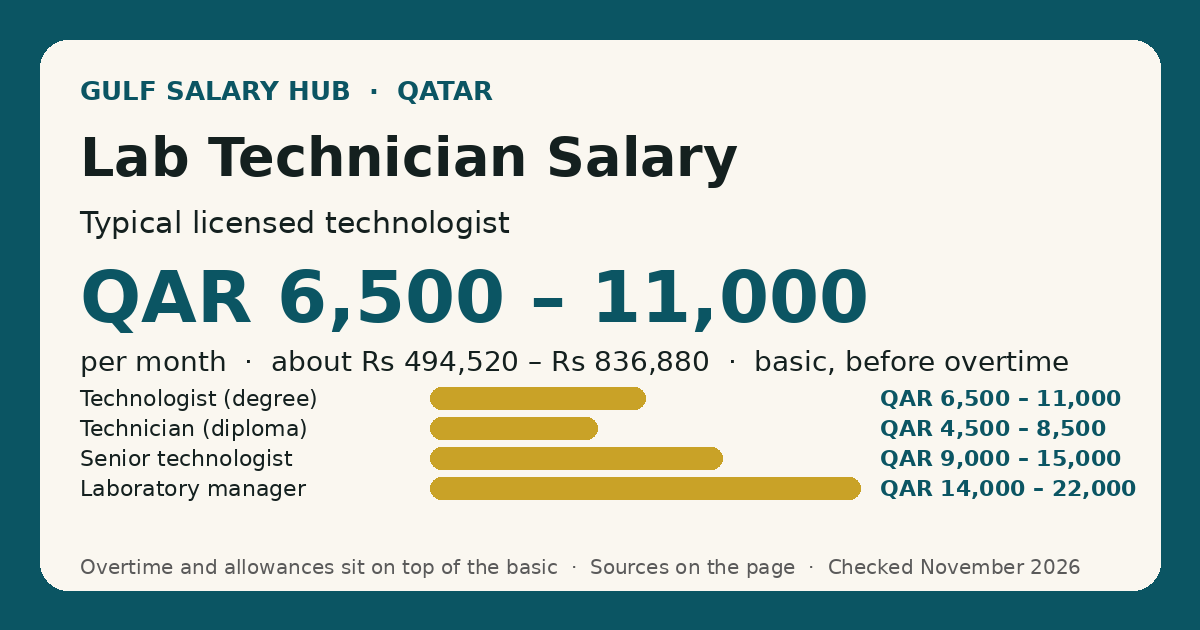
A licensed medical laboratory technologist in Qatar typically earns QAR 6,500–11,000 per month basic — the band both current guides agree on for a degree holder (BSc MLT or BMLS) with a few years of experience, before overtime. Diploma-level technicians earn QAR 4,500–8,500, senior technologists and specialists QAR 9,000–15,000, and laboratory managers QAR 14,000–22,000. A QCHP licence is mandatory, and most packages add housing or an allowance, annual flights and medical cover.
Salary by segment — the part most websites hide
Read the eligibility note first, because it decides which of the figures below you can actually apply for. Expatriates CAN work as lab technicians in Qatar – all five guides reviewed for this page are written for international laboratory professionals, and technical laboratory positions in Qatar remain predominantly expatriate-staffed. Two conditions come with that. First, a QCHP licence is mandatory before you start work – the Department of Healthcare Professions licenses medical laboratory technicians and technologists, distinguishing them by qualification: a recognised diploma or degree, DataFlow primary-source verification of your credentials, and the Prometric lab exam, with about two years of post-qualification laboratory experience. The file is opened by the employer, and the whole process takes about eight to twelve weeks from a complete application to the licence. Second, Qatarization is reaching the profession from the top: it is gradually being applied to laboratory management roles – so the strongest lanes for international lab professionals are bench-level technician and technologist posts, plus specialist roles in molecular diagnostics, histopathology, microbiology and blood banking. Third, a single “average salary” for this job would mislead you, because pay runs on licence category – Technician, Technologist or Specialist – and on your qualification, not on one flat rate: a diploma holder is licensed as a Technician and a degree holder as a Technologist, and only a degree moves you to the technologist band. Overtime and allowances are NOT included in any figure on this page – treat them as extras on top of the basic in your contract:
| Segment | Monthly salary | Note |
|---|---|---|
| Medical laboratory technologist – the headline band | QAR 6,500 – 11,000 / month | Documented in current guides reviewed Nov 2026: this is the band BOTH primary guides agree on for a licensed technologist – the first guide puts a degree-level technologist (BSc MLT or BMLS) at QAR 6,000 – 12,000 a month, and the second guide puts a licensed medical laboratory technologist in Qatar at QAR 6,500 – 11,000 a month, so the headline is their overlap. The cross-check guides agree: one puts technologists with 3 – 8 years at QAR 8,000 – 11,000, inside the same band, and the other puts mid level at QAR 11,000 – 14,000, starting at the top of it. This is a monthly basic, before overtime and allowances |
| Medical laboratory technician (diploma, DMLT) | QAR 4,500 – 8,500 / month | Documented in current guides reviewed Nov 2026: the first guide puts a diploma-level technician (DMLT or an equivalent two- to three-year diploma) at QAR 4,500 – 8,500 a month, about 30 – 35% below the technologist band. The cross-check guides put entry level at QAR 6,000 – 8,000 and QAR 8,000 – 10,000, inside or at the top of the same band, and the second guide notes diploma holders typically earn 15 – 25% less than BSc MLT holders. Diploma holders are licensed as Technicians by the Department of Healthcare Professions, while degree holders are licensed as Technologists – the qualification, not the job title at home, decides the band |
| Senior technologist / specialist (histology, microbiology, molecular, blood bank) | QAR 9,000 – 15,000 / month | Documented in current guides reviewed Nov 2026: the first guide puts a senior technologist, specialist or section supervisor at QAR 9,000 – 15,000 a month. The second guide puts senior technologists with five-plus years 20 – 35% above the bench band, and the cross-check guides put senior / specialist at QAR 11,000 – 13,500 and senior level at QAR 15,000 – 18,000. Specialists in histopathology, microbiology, molecular diagnostics and blood banking command the premium – the Qatar Genome Programme is driving demand for molecular and genetic testing expertise |
| Laboratory manager / clinical scientist (MSc) | QAR 14,000 – 22,000 / month | Documented in current guides reviewed Nov 2026: the first guide puts a laboratory manager or clinical scientist (MSc) at QAR 14,000 – 22,000 a month. Management, quality assurance and laboratory information system roles sit at this level, and the cross-check guide puts senior level at QAR 15,000 – 18,000, inside the same band. Qatarization is gradually being applied to laboratory management roles, so these posts are the ones where a local candidate is increasingly preferred |
| Modelled average – context only | ~QAR 3,868 / month | Documented in a cross-check reviewed Nov 2026: a salary database puts the average laboratory technician in Qatar at about QAR 3,868 a month, from 10 salaries (updated 10 September 2026), with a reported range of QAR 2,972 – 5,032. A modelled average blends diploma technicians, unlicensed and early-career staff into one number and is not an offer – and the cross-check guide notes its postings are mainly industrial and environmental labs, not hospital labs. It is context, and it sits below the licensed technologist band because it describes a different mix of workers |
What the job involves
Laboratory work in Qatar hospitals and reference laboratories: receiving and processing patient samples, running routine analysers in haematology, clinical chemistry and microbiology, preparing slides and cultures, blood-bank testing and cross-matching, quality-control checks on every run, recording and validating results in the laboratory information system, maintaining and calibrating analysers, and following infection-control and biosafety rules. Specialist sections add histopathology slide preparation, molecular and PCR testing, flow cytometry and cytogenetics – Sidra Medicine runs advanced genomic and molecular testing, and the Qatar Genome Programme is creating demand for molecular biology and genetic testing expertise. HMC’s central laboratory holds CAP accreditation and ISO 15189 certification, so quality-system work is part of the job at every level. Hospital laboratories run 24 hours on rotating morning, evening and night shifts, and most contracts run two years.
What your total package usually includes
For lab technicians in Qatar, the package lines that decide the real offer are the licence category on the offer, whether housing is a room or an allowance of QAR 3,000 – 5,000, and how night shifts and overtime are counted – read the table with those in mind:
| Part of the package | What it usually means in practice |
|---|---|
| Housing | Shared accommodation is standard at entry level. Some employers give a housing allowance instead — a room and cash are not worth the same, so ask which one your offer includes. |
| Transport | Company transport to the site is common on project work. City jobs may give a transport allowance, or nothing at all — and if it is nothing, that cost comes out of your salary. |
| Overtime | Paid on top of basic when hours run long. Get the rate — and how the hours are counted — in writing. "Overtime available" with no rate attached means very little. |
| Medical | Employer-provided health insurance, arranged as part of the job. You should receive the insurance card — not have to chase anyone for it. |
| Air ticket | A return ticket home every 1–2 years is standard in most contracts. Check the interval, and whether it covers family (at this level, it usually covers you only). |
Count these before you judge any offer. A slightly lower salary with housing, transport and overtime paid can leave you with more in savings at month's end than a higher headline figure without them.
On a Qatar lab offer, confirm in writing: the licence category (QCHP/DHP) and the basic salary for that category, whether accommodation is a furnished room or a housing allowance of QAR 3,000 – 5,000, how night differentials and overtime are calculated and recorded, and whether the employer covers DataFlow verification and exam costs – those answers are worth more than a small difference in the basic figure.
How pay is structured for lab technicians in Qatar
Lab technicians in Qatar are paid a fixed monthly basic salary through the Wage Protection System, set by the licence category on the offer – Technician, Technologist or Specialist – with night-shift differentials and overtime on top, and the rates and how hours are recorded belong in the contract, because the basic, not the overtime, decides your end-of-service gratuity. Night-shift differentials typically add 10 – 25% of basic salary for the nights worked, and overtime at reputable employers is paid at 125 – 150% of the hourly rate. Qatar levies no personal income tax, so the agreed basic is the take-home figure before any deduction the contract itself states. Housing is usually provided as shared accommodation, or as an allowance of roughly QAR 3,000 – 5,000 a month; transport runs by hospital bus or an allowance. An annual return ticket and 30 days of paid leave are common, medical insurance is provided, and end-of-service is at least three weeks of basic pay per year of service. Salaries are paid through the Wage Protection System. The employer sponsors the work visa once the licence is issued, and the employer opens the QCHP file. Contracts are typically two years. Because the riyal is pegged to the US dollar – one riyal is about Rs 76.08 – small riyal differences are large money at home: QAR 500 a month is about Rs 38,040, so the provided parts of the package (room and transport) deserve the same attention as the salary figure itself.
Where lab technician jobs are concentrated in Qatar
Doha holds most of the laboratory work – Hamad Medical Corporation runs Qatar’s main hospital laboratories from its central laboratory, which holds CAP accreditation and ISO 15189 certification, and Sidra Medicine runs advanced genomic and molecular testing, with the Primary Health Care Corporation employing laboratory staff across its health centres. Private hospitals such as Al-Ahli and Doha Clinic Hospital, and standalone diagnostic centres, add steady demand in the capital. The Qatar Genome Programme is driving demand for molecular biology and genetic testing expertise beyond traditional clinical laboratory skills, and point-of-care testing is expanding across primary healthcare centres. Government employers pay in the upper half of the range with the strongest packages; private hospitals and diagnostic centres pay towards the lower half, but hire in steady numbers and are the easiest first Qatar job for a newly licensed candidate.
How to get this job safely
1. Apply to the company directly, or go through a licensed Overseas Employment Promoter — nobody else. 2. Before you pay a single rupee, verify the agent's licence and check the job has a Permission Tracking Number (the guide below shows how). 3. Get the salary, the overtime rate and the accommodation written into the contract — a verbal promise made in an agent's office tends to disappear at the airport. 4. Never hand your original passport to an unlicensed person, and never travel for work without the Protector stamp.
Frequently asked questions
Can an expatriate work as a lab technician in Qatar?
Yes. All five guides reviewed for this page are written for international laboratory professionals, and technical laboratory positions in Qatar remain predominantly expatriate-staffed. The condition is a QCHP licence before you start work. One honest caveat: Qatarization is gradually being applied to laboratory management roles – so target bench-level technician and technologist posts, which remain predominantly expatriate-staffed, or specialist roles (molecular diagnostics, histopathology, microbiology, blood banking), where international hiring stays strong and the Qatar Genome Programme is creating new demand.
What is the typical lab technician salary in Qatar?
QAR 6,500–11,000 a month basic for a licensed medical laboratory technologist with a degree (BSc MLT or BMLS) and a few years of experience – the band both current guides agree on. Diploma-level technicians earn QAR 4,500–8,500, senior technologists and specialists QAR 9,000–15,000, and laboratory managers QAR 14,000–22,000. Overtime and allowances sit on top, and most packages include housing or an allowance of QAR 3,000–5,000 a month, annual flights home and medical cover.
What is the difference between a lab technician and a lab technologist in Qatar?
Your qualification decides, not the title on your home job description. A two- to three-year diploma such as the Indian DMLT makes you a Medical Laboratory Technician; a three- to four-year degree such as BSc MLT or BMLS makes you a Medical Laboratory Technologist, with independent bench work, result validation, quality control and supervision of technicians. The technologist band runs about 30–35% above the technician band, and only completing a recognised degree moves you across – experience alone does not change the licensed title. If you obtain a bachelor’s degree while working in Qatar, you can apply for reclassification to technologist grade, but the new qualification must be from a DHP-recognised institution and verified through PSV.
How do I get licensed to work as a lab technician in Qatar?
You need a QCHP licence before you can start work. The route is: hold a recognised diploma or degree in medical laboratory science, complete DataFlow primary-source verification of your credentials, and pass the Prometric lab exam for your title – the exam is 100 to 150 multiple-choice questions over two to three hours, with a pass mark of about 50 to 60% by title. About two years of post-qualification laboratory experience is needed, plus a good-standing certificate, a medical fitness certificate and police clearance. Unlike the UAE, the file is opened by the employer in Qatar, and the whole process takes about eight to twelve weeks from a complete application to the licence. Get DataFlow and the exam done before you apply – licensable candidates get hired faster, because the employer carries zero licensing risk.
Why do some websites say lab technicians earn QAR 3,868, or QAR 8,000–18,000?
All three figures are real, and they describe different lab workers. The QAR 3,868 figure is a modelled average across all laboratory-technician salaries on one salary database (10 salaries, updated 10 September 2026) – it blends diploma technicians, unlicensed and early-career staff into one number, and its postings are mainly industrial and environmental labs, not hospital labs. The QAR 6,500–11,000 band – our headline – is the degree-level technologist band both detailed guides agree on. The QAR 8,000–18,000 figure is a licensing guide’s ladder by grade – entry QAR 8,000–10,000, mid QAR 11,000–14,000, senior QAR 15,000–18,000 – which starts at the top of our technologist band and runs up through senior and management grades. Before comparing two figures, check which title each one describes.
Which laboratories pay lab technicians the most in Qatar?
Hamad Medical Corporation runs Qatar’s main hospital laboratories and is the premium employer – its central laboratory holds CAP accreditation and ISO 15189 certification, and government employers pay in the upper half of the range with housing or a housing allowance and annual flights. Sidra Medicine runs advanced genomic and molecular testing, and the Primary Health Care Corporation also employs laboratory staff. Private hospitals such as Al-Ahli and Doha Clinic Hospital, and standalone diagnostic centres, pay towards the lower half of the band, but hire in steady numbers. Blood banks and molecular or genetics laboratories pay a premium for specialists.