Salary by segment — the part most websites hide
A single “average salary” for this job would mislead you. “Chef” covers a whole kitchen ladder — kitchen helper and commis at the entry end, cook grades in the middle (often hired for one cuisine: Indian, Arabic, continental, bakery or pastry), and chef de partie, sous chef and head chef grades above them — and each grade pays differently. This page headlines the grades a new arrival is actually hired into, and treats the senior grades and the all-levels averages as context only. Overtime is NOT included in any figure on this page:
| Segment | Monthly salary | Note |
|---|---|---|
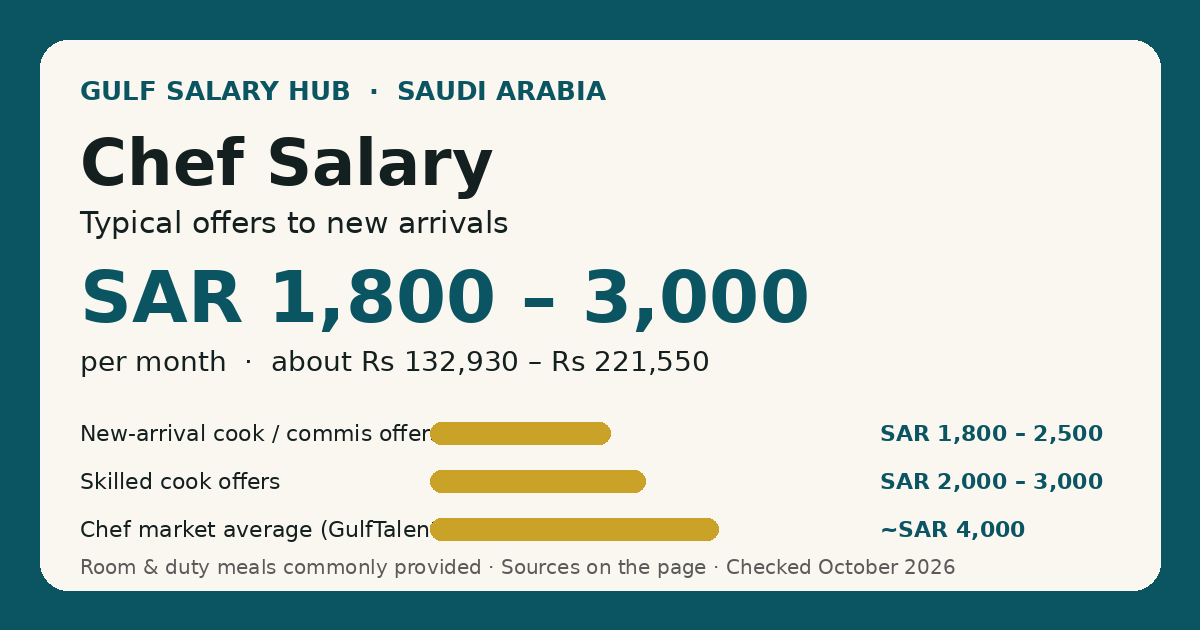
| New arrival — cook and commis chef offers | SAR 1,800 – 2,500 / month | Documented in current advertisements reviewed Oct 2026: a direct-restaurant cook listing at SAR 2,000 a month for 3–5 years of experience, rising to SAR 2,500 for a professional cook with Gulf experience who can speak English or Arabic, with accommodation, iqama and insurance provided by the sponsor; and a large catering company hiring Arabic, bakery, pastry and continental cooks at SAR 1,800–2,000 (Arabic cooks up to SAR 2,800), with food and accommodation provided. The headline band starts where those entry offers overlap |
| Skilled cook offers — experienced commis and specialist cooks | SAR 2,000 – 3,000 / month | Documented in the same advertisement review plus current board bands: Bayt Saudi cooking listings carry SAR 1,875–3,750 bands for continental cook and assistant commis chef roles, bakery chef advertisements reviewed this run run up to SAR 3,000, and current Saudi chef pay guides put cook and commis grades at SAR 1,800–3,000 and SAR 2,000–3,200. A proven cuisine specialisation — tandoor, Arabic, continental, bakery or pastry — is what puts a cook in this segment rather than the entry one |
| Market figures, all experience levels — read with care | Chef ~SAR 4,000 / month average (GulfTalent, 19 chefs); Commi Chef ~SAR 2,334 / month average (Naukrigulf, 11 salaries) | Reported-salary platforms mix every grade together. GulfTalent puts the average Chef salary in Saudi Arabia at SAR 4,000 a month (lowest SAR 2,500, highest SAR 10,500, from 19 registered chefs), and its related-titles figures put a Head Chef at about SAR 5,000 and an Executive Chef at about SAR 18,000 — senior grades, not first offers. Naukrigulf puts Commi Chef at an average of SAR 2,334 a month from 11 salaries (range SAR 2,000–3,603), which sits inside the skilled segment above. Neither average is a new-arrival offer |
What the job involves
Preparing and cooking dishes to the recipe and portion standard of the house — in restaurants, one cuisine or one station (hot kitchen, cold kitchen, tandoor and grill, bakery or pastry); in catering companies, bulk cooking for hundreds or thousands of meals a day to a fixed menu cycle; commis work supporting a station — washing, peeling and cutting, marinating, basic sauces and stocks, and keeping the station stocked and clean; following food-safety and hygiene rules — correct storage temperatures, labelling, separate boards for raw and cooked food, and cleaning schedules; checking deliveries and stock, reporting shortages and waste; and, at chef de partie level and above, running a station through service, training commis staff and controlling food cost on that section. Trial cooking tests are standard before a skilled offer is confirmed, and split shifts are the normal pattern in restaurants.
What your total package usually includes
For kitchen staff, the provided parts of the package — a bed, duty meals and the iqama costs carried by the employer — are worth a large share of a cook's salary, and they differ between restaurants, catering companies and private households:
| Part of the package | What it usually means in practice |
|---|---|
| Housing | Shared accommodation is standard at entry level. Some employers give a housing allowance instead — a room and cash are not worth the same, so ask which one your offer includes. |
| Transport | Company transport to the site is common on project work. City jobs may give a transport allowance, or nothing at all — and if it is nothing, that cost comes out of your salary. |
| Overtime | Paid on top of basic when hours run long. Get the rate — and how the hours are counted — in writing. "Overtime available" with no rate attached means very little. |
| Medical | Employer-provided health insurance, arranged as part of the job. You should receive the insurance card — not have to chase anyone for it. |
| Air ticket | A return ticket home every 1–2 years is standard in most contracts. Check the interval, and whether it covers family (at this level, it usually covers you only). |
Count these before you judge any offer. A slightly lower salary with housing, transport and overtime paid can leave you with more in savings at month's end than a higher headline figure without them.
On a cook or chef offer, confirm in writing: accommodation provided and whether anything is deducted for it, duty meals or food provided, who pays the iqama and insurance costs (the advertisements we reviewed put them on the sponsor), and whether the role is a company contract or a private-household job — the pay and the rules are different.
How pay is structured for cooks and chefs
Kitchen staff are paid a fixed monthly salary through the Wage Protection System. Two variable parts sit on top and should never be counted in advance: overtime in peak periods — Ramadan, Hajj and Umrah seasons, banquets and catering surges — and, in some restaurants and hotels, a service-charge share, which changes month to month. Catering-company contracts are the plainest: the written salary plus provided food and accommodation is the whole package. Judge every offer on its written salary and its provided bed and food first.
Where chef and cook jobs are concentrated
Riyadh holds the most kitchen work — restaurants, hotel kitchens, catering companies and cloud kitchens across the capital. Makkah and Madinah hire cooks all year for pilgrim hotels and catering, with the heaviest demand and overtime in Ramadan and the Hajj season. Jeddah follows with restaurants, hotels and catering on the Red Sea coast, and the Eastern Province (Khobar, Dammam and Jubail) adds industrial catering for compounds and worksites — the bulk-cooking employers. Large catering companies are the biggest single route in for overseas cooks; branded hotels are the better ladder for graded chefs.
How to get this job safely
1. Apply to the company directly, or go through a licensed Overseas Employment Promoter — nobody else. 2. Before you pay a single rupee, verify the agent's licence and check the job has a Permission Tracking Number (the guide below shows how). 3. Get the salary, the overtime rate and the accommodation written into the contract — a verbal promise made in an agent's office tends to disappear at the airport. 4. Never hand your original passport to an unlicensed person, and never travel for work without the Protector stamp.
Frequently asked questions
Why do some websites say chefs in Saudi Arabia earn SAR 10,000 or more?
Those figures describe the top of the ladder — executive chefs and corporate chefs in large hotels — or modelled averages that mix them in with everyone else. GulfTalent’s own related-titles data puts an Executive Chef at about SAR 18,000 a month, but the same source puts the overall Chef average at SAR 4,000 from a small sample of 19, and current advertisements for the cook and commis grades a new arrival is hired into cluster at SAR 1,800–3,000. Plan your first contract on the grade you are actually being hired for.
Is accommodation and food included for cooks and chefs?
Commonly, yes — the advertisements we reviewed for restaurant and catering cooks included company accommodation, and the catering listing also included food; one direct-restaurant listing stated accommodation, iqama and insurance provided by the sponsor. Duty meals are a normal part of kitchen work. Private-household and family cook roles are the exception to compare carefully: they are live-in, and the family cook advertisements we saw ran lower, around SAR 1,300–1,700 plus food — a different job from a restaurant or catering company contract. Confirm every part in writing, including whether anything is deducted for housing or food.
Do I need a certificate to work as a cook in Saudi Arabia?
For cook and commis grades, employers hire on experience and a trial cooking test rather than a formal diploma — the advertisements we reviewed asked for 2–5 years of kitchen experience and a proven cuisine, not a certificate. Formal culinary qualifications start to matter from chef de partie and sous chef level upward. Every food handler must also pass the medical fitness checks that come with the work visa and iqama process, and employers apply food-hygiene training on the job — if an agent tries to sell you a ‘chef certificate’ as a visa requirement, treat that as a warning sign (see the safety box on this page).
Is chef work open to expatriates in Saudi Arabia?
Yes — restaurant, hotel and catering kitchens across Saudi Arabia hire expatriate cooks and chefs from Pakistan, India, Bangladesh, Nepal, the Philippines and elsewhere every month, and the advertisements reviewed for this page were openly recruiting overseas candidates for Saudi kitchens. The grades are not a Saudi-only occupation. What decides your offer is your cuisine, your experience and your trial test — not your nationality.
How can I get a better chef salary in Saudi Arabia?
Specialise and prove it: a cook who can hold a tandoor, bakery or continental station alone is worth more than a general helper, and the advertisements we reviewed paid a clear Gulf-experience premium (SAR 2,000 rising to SAR 2,500 for a Gulf-experienced professional cook). The ladder after that is commis → cook → chef de partie (current pay guides put that grade around SAR 3,000–5,000) → sous chef and head chef, and each step is won by station skill, speed under service pressure, hygiene discipline and, for the senior grades, food-cost and team management.