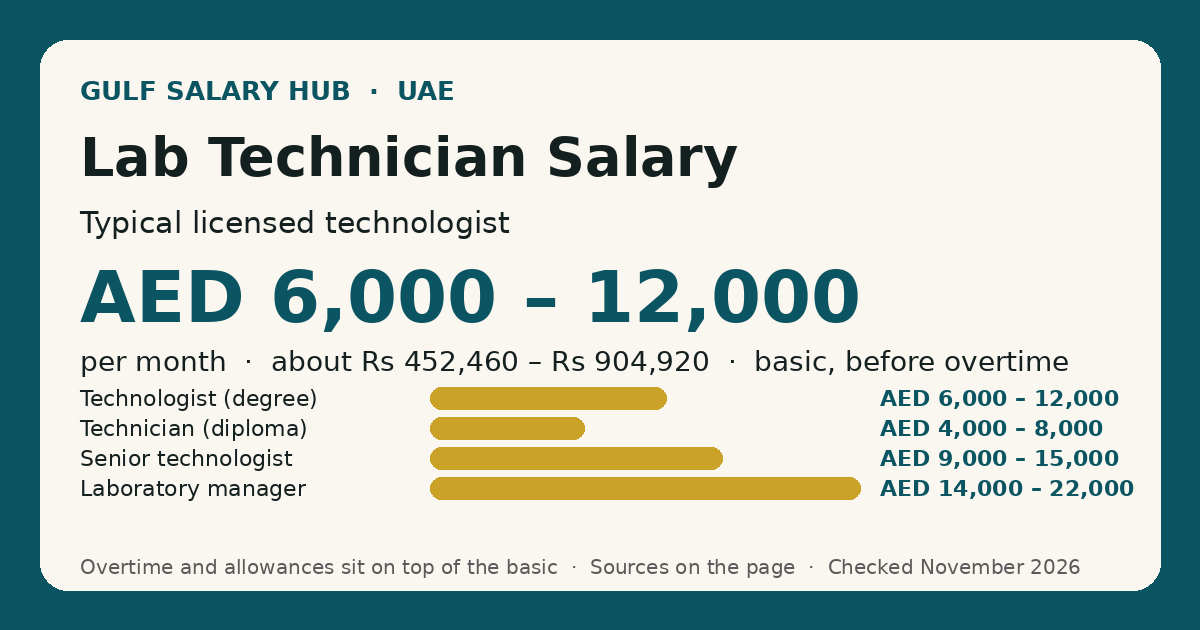
A licensed medical laboratory technologist in the UAE typically earns AED 6,000–12,000 per month basic — the band both current guides agree on for a degree holder (BSc MLT or BMLS) with a few years of experience, before overtime. Diploma-level technicians earn AED 4,000–8,000, senior technologists and specialists AED 9,000–15,000, and laboratory managers AED 14,000–22,000. A DHA, DOH, MOHAP or SHA licence is mandatory, and most packages add housing, annual flights and medical cover.
Salary by segment — the part most websites hide
Read the eligibility note first, because it decides which of the figures below you can actually apply for. Expatriates CAN work as lab technicians in the UAE – all three guides reviewed for this page are written for international laboratory professionals, and the largest workforce segments are from India, the Philippines, Egypt and Pakistan. Two conditions come with that. First, a UAE licence is mandatory before you start work – DHA for Dubai, DOH for Abu Dhabi, MOHAP for the Northern Emirates and SHA for Sharjah – a recognised diploma or degree, DataFlow verification of your credentials, and the licensing exam where your title requires one, with about two years of post-qualification laboratory experience. The UAE allows self-application, and the whole process takes about eight to sixteen weeks. Second, Emiratisation is reshaping the profession: UAE nationals are being recruited into supervisory and management roles – so the strongest lanes for international lab professionals are bench-level technician and technologist posts, which remain predominantly expatriate-staffed, plus specialist roles in molecular diagnostics, histopathology, microbiology and blood banking. Third, a single “average salary” for this job would mislead you, because pay runs on licence category – Technician, Technologist or Specialist – and on your qualification, not on one flat rate: a diploma holder is licensed as a Technician and a degree holder as a Technologist, and only a degree moves you to the technologist band. Overtime and allowances are NOT included in any figure on this page – treat them as extras on top of the basic in your contract:
| Segment | Monthly salary | Note |
|---|---|---|
| Medical laboratory technologist – the headline band | AED 6,000 – 12,000 / month | Documented in current guides reviewed Nov 2026: this is the band BOTH primary guides agree exactly for a licensed technologist – the first guide puts a degree-level technologist (BSc MLT or BMLS) at AED 6,000 – 12,000 a month, and the second guide puts a licensed medical laboratory technologist in the UAE at AED 6,000 – 12,000 a month. The cross-check guide puts mid level at AED 8,000 – 12,000, inside the same band. This is a monthly basic, before overtime and allowances |
| Medical laboratory technician (diploma, DMLT) | AED 4,000 – 8,000 / month | Documented in current guides reviewed Nov 2026: the first guide puts a diploma-level technician (DMLT or an equivalent two- to three-year diploma) at AED 4,000 – 8,000 a month, about 30 – 35% below the technologist band. The cross-check guide puts entry level at AED 5,000 – 7,000, inside the same band, and the second guide notes technicians cluster at AED 6,000 – 8,500. Diploma holders are licensed as Technicians by DHA, DOH, MOHAP or SHA, while degree holders are licensed as Technologists – the qualification, not the job title at home, decides the band |
| Senior technologist / specialist (histology, microbiology, molecular, blood bank) | AED 9,000 – 15,000 / month | Documented in current guides reviewed Nov 2026: the first guide puts a senior technologist, specialist or section supervisor at AED 9,000 – 15,000 a month. The second guide puts senior technologists with five-plus years at AED 10,000 – 15,000 at good hospitals, 20 – 35% above the bench band, and the cross-check guide puts senior level at AED 13,000 – 22,000. Specialists in histopathology, microbiology, molecular diagnostics and blood banking command the premium |
| Laboratory manager / clinical scientist (MSc) | AED 14,000 – 22,000 / month | Documented in current guides reviewed Nov 2026: the first guide puts a laboratory manager or clinical scientist (MSc) at AED 14,000 – 22,000 a month. Management, quality assurance and laboratory information system roles sit at this level, and the cross-check guide puts senior level at AED 13,000 – 22,000 |
| Modelled average – context only | ~AED 4,065 / month | Documented in a cross-check reviewed Nov 2026: a salary database puts the average laboratory technician in the UAE at about AED 4,065 a month, from 87 salaries (updated 16 November 2026), with a reported range of AED 1,966 – 8,405. A modelled average blends diploma technicians, unlicensed and early-career staff into one number and is not an offer – it is context, and it sits below the licensed technologist band because it describes a different mix of workers |
What the job involves
Laboratory work in UAE hospitals and reference laboratories: receiving and processing patient samples, running routine analysers in haematology, clinical chemistry and microbiology, preparing slides and cultures, blood-bank testing and cross-matching, quality-control checks on every run, recording and validating results in the laboratory information system, maintaining and calibrating analysers, and following infection-control and biosafety rules. Specialist sections add histopathology slide preparation, molecular and PCR testing, flow cytometry and cytogenetics. Hospital laboratories run 24 hours on rotating morning, evening and night shifts, and most contracts run two years. The UAE requires ISO 15189 accreditation for all laboratories, so quality-system work is part of the job at every level.
What your total package usually includes
For lab technicians in the UAE, the package lines that decide the real offer are the licence category on the offer, whether housing is a room or an allowance, and how night shifts and overtime are counted – read the table with those in mind:
| Part of the package | What it usually means in practice |
|---|---|
| Housing | Shared accommodation is standard at entry level. Some employers give a housing allowance instead — a room and cash are not worth the same, so ask which one your offer includes. |
| Transport | Company transport to the site is common on project work. City jobs may give a transport allowance, or nothing at all — and if it is nothing, that cost comes out of your salary. |
| Overtime | Paid on top of basic when hours run long. Get the rate — and how the hours are counted — in writing. "Overtime available" with no rate attached means very little. |
| Medical | Employer-provided health insurance, arranged as part of the job. You should receive the insurance card — not have to chase anyone for it. |
| Air ticket | A return ticket home every 1–2 years is standard in most contracts. Check the interval, and whether it covers family (at this level, it usually covers you only). |
Count these before you judge any offer. A slightly lower salary with housing, transport and overtime paid can leave you with more in savings at month's end than a higher headline figure without them.
On a UAE lab offer, confirm in writing: the licence category (DHA, DOH, MOHAP or SHA) and the basic salary for that category, whether accommodation is a furnished room or a housing allowance of AED 2,500 – 5,000, how night differentials and overtime are calculated and recorded, and whether the employer covers DataFlow verification and exam costs – those answers are worth more than a small difference in the basic figure.
How pay is structured for lab technicians in the UAE
Lab technicians in the UAE are paid a fixed monthly basic salary in dirhams, set by the licence category on the offer – Technician, Technologist or Specialist – with night-shift differentials and overtime on top, and the rates and how hours are recorded belong in the contract, because the basic, not the overtime, decides your end-of-service gratuity. The UAE levies no personal income tax, so the agreed basic is the take-home figure before any deduction the contract itself states. Housing is usually provided as shared accommodation, or as an allowance of roughly AED 2,500 – 5,000 a month; transport runs by hospital bus or an allowance. An annual return ticket and 30 days of paid leave are common, medical insurance is mandatory and provided, and end-of-service accrues at 21 days of basic pay per year for the first five years and 30 days after. Salaries are paid through the Wage Protection System. The employer sponsors the work visa once the licence is issued, and many employers cover the DataFlow verification and exam costs. Contracts are typically two years. Because the dirham is pegged to the US dollar – one dirham is about Rs 75.41 – small dirham differences are large money at home: AED 500 a month is about Rs 37,705, so the provided parts of the package (room and transport) deserve the same attention as the salary figure itself.
Where lab technician jobs are concentrated in the UAE
Dubai holds the most laboratory work – Dubai Health runs Rashid Hospital and Dubai Hospital, 24-hour high-volume laboratories with full automation lines, and the emirate hosts the largest private reference laboratories. Abu Dhabi follows with SEHA, the largest government laboratory network – Sheikh Khalifa Medical City and Tawam Hospital run reference-level laboratories – plus Cleveland Clinic Abu Dhabi, one of the most technologically advanced laboratories in the region. Sharjah adds Al Qassimi Hospital and its own licensing authority (SHA), and the Northern Emirates run smaller MOHAP-licensed laboratories. Private reference laboratories such as Unilabs, Biolab and Core Lab employ substantial numbers of technicians across the Emirates. Government hospitals pay the upper band with the strongest packages; private diagnostic chains pay toward the lower half to the middle of the band, but hire in the largest numbers and are the easiest first Gulf job for a newly licensed candidate.
How to get this job safely
1. Apply to the company directly, or go through a licensed Overseas Employment Promoter — nobody else. 2. Before you pay a single rupee, verify the agent's licence and check the job has a Permission Tracking Number (the guide below shows how). 3. Get the salary, the overtime rate and the accommodation written into the contract — a verbal promise made in an agent's office tends to disappear at the airport. 4. Never hand your original passport to an unlicensed person, and never travel for work without the Protector stamp.
Frequently asked questions
Can an expatriate work as a lab technician in the UAE?
Yes. All three guides reviewed for this page are written for international laboratory professionals – the largest workforce segments are from India, the Philippines, Egypt and Pakistan, and hospital laboratories recruit them every year. The condition is a UAE licence before you start work. One honest caveat: Emiratisation is moving UAE nationals into supervisory and management roles – so target bench-level technician and technologist posts, which remain predominantly expatriate-staffed, or specialist roles (molecular diagnostics, histopathology, microbiology, blood banking), where international hiring stays strong.
What is the typical lab technician salary in the UAE?
AED 6,000–12,000 a month basic for a licensed medical laboratory technologist with a degree (BSc MLT or BMLS) and a few years of experience – the band both current guides agree on exactly. Diploma-level technicians earn AED 4,000–8,000, senior technologists and specialists AED 9,000–15,000, and laboratory managers AED 14,000–22,000. Overtime and allowances sit on top, and most packages include housing or an allowance, annual flights home and medical cover.
What is the difference between a lab technician and a lab technologist in the UAE?
Your qualification decides, not the title on your home job description. A two- to three-year diploma such as the Indian DMLT makes you a Medical Laboratory Technician; a three- to four-year degree such as BSc MLT or BMLS makes you a Medical Laboratory Technologist, with independent bench work, result validation, quality control and supervision of technicians. The technologist band runs about 30–35% above the technician band, and only completing a recognised degree moves you across – experience alone does not change the licensed title. DHA licenses the two titles under exam codes LAB5601 (technician) and LAB5631 (technologist).
Do I need a licence before I apply?
You need a UAE licence before you can start work, and you should start the application before you apply for jobs – employers need your licence number before they issue a work visa. The route is: hold a recognised diploma or degree, complete DataFlow primary-source verification, and pass the licensing exam for your authority – DHA for Dubai, DOH for Abu Dhabi, MOHAP for the Northern Emirates, SHA for Sharjah – where your title requires one. About two years of post-qualification laboratory experience is needed, and the whole process takes about eight to sixteen weeks from application to licence. The UAE allows self-application, so you can start without an employer. Get DataFlow and the exam done before you apply – licensable candidates get hired faster, because the employer carries zero licensing risk.
Why do some websites say lab technicians earn AED 4,065, or AED 6,000–12,000?
Both figures are real, and they describe different lab workers. The AED 4,065 figure is a modelled average across all laboratory-technician salaries on one salary database (87 salaries, updated 16 November 2026) – it blends diploma technicians, unlicensed and early-career staff into one number. The AED 6,000–12,000 band – our headline – is the degree-level technologist band both detailed guides agree on exactly. Senior and specialist figures – to AED 15,000, and laboratory managers to AED 22,000 – sit above it. Before comparing two figures, check which title each one describes.
Which laboratories pay lab technicians the most in the UAE?
Government hospitals pay the upper band with the strongest packages: SEHA runs the largest government laboratory network in Abu Dhabi – Sheikh Khalifa Medical City and Tawam Hospital run reference-level laboratories – Dubai Health runs Rashid Hospital and Dubai Hospital, 24-hour high-volume laboratories with full automation lines, and Cleveland Clinic Abu Dhabi runs one of the most technologically advanced laboratories in the region. Al Qassimi Hospital in Sharjah handles significant volumes in the Northern Emirates. Large private groups such as Unilabs, Biolab and Core Lab pay competitively and hire in large numbers. Private diagnostic chains pay toward the lower half to the middle of the band, but hire the fastest and are the easiest first Gulf job for a newly licensed candidate. Blood banks and molecular or genetics laboratories pay a premium for specialists.