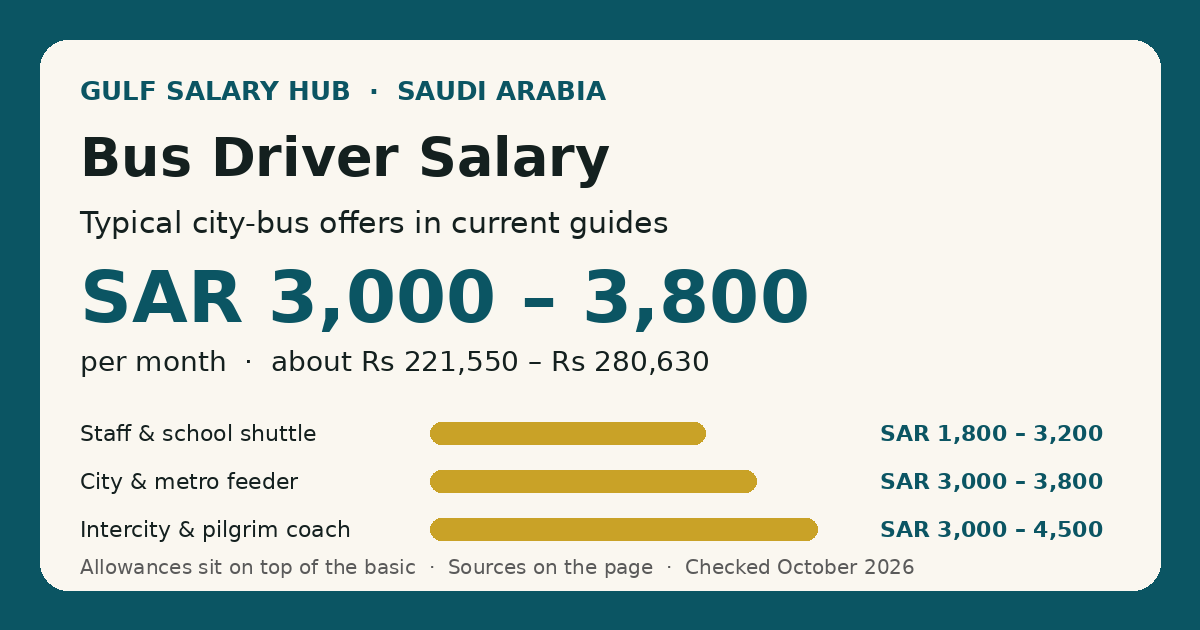
Salary by segment — the part most websites hide
A single “average salary” for this job would mislead you, because “bus driver” covers three different kinds of work. A staff or school shuttle driver on short fixed rounds is not paid as a city-bus driver on timetabled public routes, and neither is paid as an intercity or pilgrim coach driver on long highway runs — the vehicle size, the hours and the allowances all change with the job. Overtime, trip allowances and season bonuses are NOT included in any figure on this page — treat them as variable extras on top of the basic in your contract:
| Segment | Monthly salary | Note |
|---|---|---|
| Staff, school, minibus and shuttle drivers | SAR 1,800 – 3,200 / month | Documented in current guides reviewed Oct 2026: the gpgcchampawat bus guide puts staff bus drivers at SAR 2,000–3,000, school bus drivers at SAR 2,000–3,200, minibus drivers at SAR 1,800–2,800 and hotel and airport shuttle drivers at SAR 2,200–3,200, and its own staff/school/shuttle summary band is SAR 1,800–3,200; the cronosaction minibus guide puts staff transport at SAR 1,800–2,800, hospital and university shuttles at SAR 2,000–3,000 and hotel and airport shuttles at SAR 2,000–3,200. This is the largest group of bus jobs — fixed rounds, predictable hours, school drivers with long summer breaks — and the lowest-paid bus work, not city-bus pay |
| City and metro feeder bus drivers | SAR 3,000 – 3,800 / month | Documented in current guides reviewed Oct 2026: the gpgcchampawat bus guide puts city bus drivers at SAR 3,000–4,500 and metro feeder drivers at SAR 3,000–4,200, and the recipmo SAPTCO guide puts city bus drivers at SAR 2,500–3,800 plus overtime — the headline band is where those two city-bus bands overlap. City work means rotating early, late and split shifts on timetabled routes, a customer-service and safety programme after joining, and structured training; overtime and shift allowances sit on top of the basic, never in it |
| Intercity, pilgrim and tourist coach drivers | SAR 3,000 – 4,500 / month | Documented in current guides reviewed Oct 2026: BOTH main guides put intercity coach drivers at SAR 3,000–4,500 — the recipmo guide including trip allowances in that figure, the gpgcchampawat guide putting tourist coaches at the same band and pilgrim coaches at SAR 3,000–5,000 with per-trip allowances that rise sharply during Hajj. This is long-distance work — overnight stays away from home, heavy holiday and pilgrimage traffic, and the longest hours in the trade — so judge a coach offer on its basic plus its written trip-allowance terms, not on a busy Hajj month |
What the job involves
Driving a bus or coach on fixed routes and timetables — staff and school rounds, city and metro feeder routes, airport and hotel shuttles, or intercity and pilgrim coach runs between cities and holy sites; doing a walk-around check before every trip (tyres, brakes, lights, air conditioning, doors, seat belts, emergency exits, fire extinguisher and first aid kit) and reporting faults before leaving the depot; keeping passengers safe and seated, helping elderly and disabled riders board, and loading luggage correctly; following the timetable and stopping only at approved stops and stations; keeping trip logs and reporting accidents, breakdowns and delays at once; and keeping the bus clean between trips. City drivers work rotating shifts, school drivers work two short rounds a day, and coach drivers work long highway days with overnight stays — and during Hajj, Ramadan and Umrah peaks every kind of bus driver works the longest hours of the year.
What your total package usually includes
For bus drivers, the package usually comes down to depot accommodation, food or a food allowance, and how overtime, shift and trip allowances are counted — the table below shows what each part normally means in this trade:
| Part of the package | What it usually means in practice |
|---|---|
| Housing | Shared accommodation is standard at entry level. Some employers give a housing allowance instead — a room and cash are not worth the same, so ask which one your offer includes. |
| Transport | Company transport to the site is common on project work. City jobs may give a transport allowance, or nothing at all — and if it is nothing, that cost comes out of your salary. |
| Overtime | Paid on top of basic when hours run long. Get the rate — and how the hours are counted — in writing. "Overtime available" with no rate attached means very little. |
| Medical | Employer-provided health insurance, arranged as part of the job. You should receive the insurance card — not have to chase anyone for it. |
| Air ticket | A return ticket home every 1–2 years is standard in most contracts. Check the interval, and whether it covers family (at this level, it usually covers you only). |
Count these before you judge any offer. A slightly lower salary with housing, transport and overtime paid can leave you with more in savings at month's end than a higher headline figure without them.
On a bus driver offer, confirm in writing: accommodation provided or an allowance (shared depot housing is the norm), whether food or a food allowance of around SAR 200–400 is included, how overtime is counted and paid (the Labour Law rate is basic hourly plus 50 percent), how trip and shift allowances are calculated and whether they are guaranteed or variable, who pays for licence conversion and the Transport General Authority driver card, and whether the job title on the contract and work permit says bus driver — a helper or general driver title at bus-driver pay, or the reverse, follows you to the next job.
How pay is structured for bus drivers
Bus drivers are paid a fixed monthly basic salary through the Wage Protection System, with overtime on top at basic hourly rate plus 50 percent when shifts run long and shift or trip allowances on city and coach work — get every allowance rate into the contract, because a busy Hajj or Ramadan month is not the salary. School drivers work two short rounds a day with long summer breaks, city drivers rotate through early, late and split shifts, and coach drivers earn per-trip allowances that rise sharply in pilgrimage season; pilgrim companies also pay season bonuses to drivers who complete a season without accidents or complaints. The figures on this page are basic only: accommodation, food and allowances are normally separate, and a lower basic with all three provided can be worth more than a higher basic without them. Judge every offer on its written basic first — the basic (not the total) is what the end-of-service gratuity is calculated on.
Where bus driver jobs are concentrated
Riyadh is the biggest single market — the city-wide bus network and metro feeder routes run by international consortiums, plus the largest staff-transport, school and corporate fleets in the country. Jeddah, Makkah and Madinah hold the pilgrim-transport market — Umrah traffic year-round and Hajj hiring surges before Ramadan and Hajj — plus airport and hotel shuttles in Jeddah. Dammam, Khobar and Jubail add industrial staff transport for thousands of workers across shifts, and intercity networks link Taif, Abha, Qassim, Tabuk and Hail on coach routes. Schools, universities and hospitals hire shuttle drivers steadily in every major city; public operators hire in batches for new routes and before each school year.
How to get this job safely
1. Apply to the company directly, or go through a licensed Overseas Employment Promoter — nobody else. 2. Before you pay a single rupee, verify the agent's licence and check the job has a Permission Tracking Number (the guide below shows how). 3. Get the salary, the overtime rate and the accommodation written into the contract — a verbal promise made in an agent's office tends to disappear at the airport. 4. Never hand your original passport to an unlicensed person, and never travel for work without the Protector stamp.
Frequently asked questions
Why do some websites say Saudi bus drivers earn SAR 5,000 or 6,000 a month?
Those figures describe the grades above driving, not driving itself. Both guides reviewed for this page put transport supervisors and fleet coordinators at SAR 4,500–7,500 (one guide) and SAR 4,000–6,000 with 5+ years experience (the other) — jobs that manage rosters, routes and driver conduct and need computer skills, not just a licence. Vague aggregator claims of SAR 3,000–6,000 for ‘general bus drivers’ with no employer or segment split were reviewed and rejected as anchors. The two detailed guides put ordinary bus driving at SAR 1,800–3,200 for staff and shuttle work, SAR 3,000–3,800 for city buses, and SAR 3,000–4,500 for coaches. Plan your first contract on the band for the bus work you are actually hired to do.
Is bus driving open to expatriates, or is it Saudized?
Driving itself is open to expatriates. Both guides reviewed for this page describe year-round recruitment of drivers from South Asia, Egypt, Sudan and the Philippines for public transport operators, transport contractors, schools, pilgrim companies and corporate fleets, and the recipmo guide states the distinction plainly: front-desk jobs such as ticket-counter and customer-service staff are often reserved for Saudi nationals, while driving and depot support roles are the openings for overseas workers. One route restriction to know: the gpgcchampawat guide states that Muslim drivers are required for pilgrim routes entering the holy cities. No Saudization reservation for bus drivers as such was found in the sources reviewed. Never pay anyone for a visa: the employer applies for the permit in your name.
What licence do I need to drive a bus in Saudi Arabia?
A Saudi heavy or public transport licence — your home-country licence alone is not enough. Both guides agree on the route: after the iqama is issued, the employer arranges conversion through an approved driving school (eye test, medical fitness certificate, translation of your home licence, and a practical test on a full-size bus covering reversing, parking and city driving), and public transport drivers also need a public transport driving permit plus a Transport General Authority driver card before carrying passengers. Public transport roles normally require age 25 or over and 2–5 years of bus or heavy-vehicle experience. Employers normally pay the conversion cost — confirm it in writing, and confirm the company’s policy on traffic fines, which are linked to the driver’s licence.
What is the difference between a minibus driver, a city bus driver and a coach driver?
The vehicle and the day. A minibus driver (roughly 14–30 seats) runs staff, hotel, airport and small tour groups on short fixed rounds, often on a private-licence-sized vehicle, and is paid in the staff/shuttle band. A city bus driver runs a full-size bus on timetabled public routes with many stops, rotating shifts and a customer-service programme, and is paid in the headline band. A coach driver runs long highway trips between cities or pilgrim sites, stays overnight away from home, and earns trip allowances on top of the basic — the highest ordinary driver band, and the one with the longest hours. Check which of the three the advertisement actually describes before you compare its salary with this page.
How can I earn more as a bus driver in Saudi Arabia?
Move up the vehicle and route ladder, and keep a clean record. The guides reviewed agree the steps are: staff or school shuttle work first, then city and metro feeder routes with a clean safety record, then intercity and pilgrim coach work for drivers with long-distance experience and knowledge of the Makkah and Madinah roads. After that, the ladder leaves driving itself: senior driver or trainer roles for experienced safe drivers, then transport supervisor or dispatcher work (SAR 4,500–7,500 in one guide) for drivers with basic English or Arabic and computer skills. Basic Arabic, route knowledge, GPS and trip-log systems, and defensive-driving training are what employers name as the extras that earn better routes — and a record with no major accidents is the single biggest plus on any application.