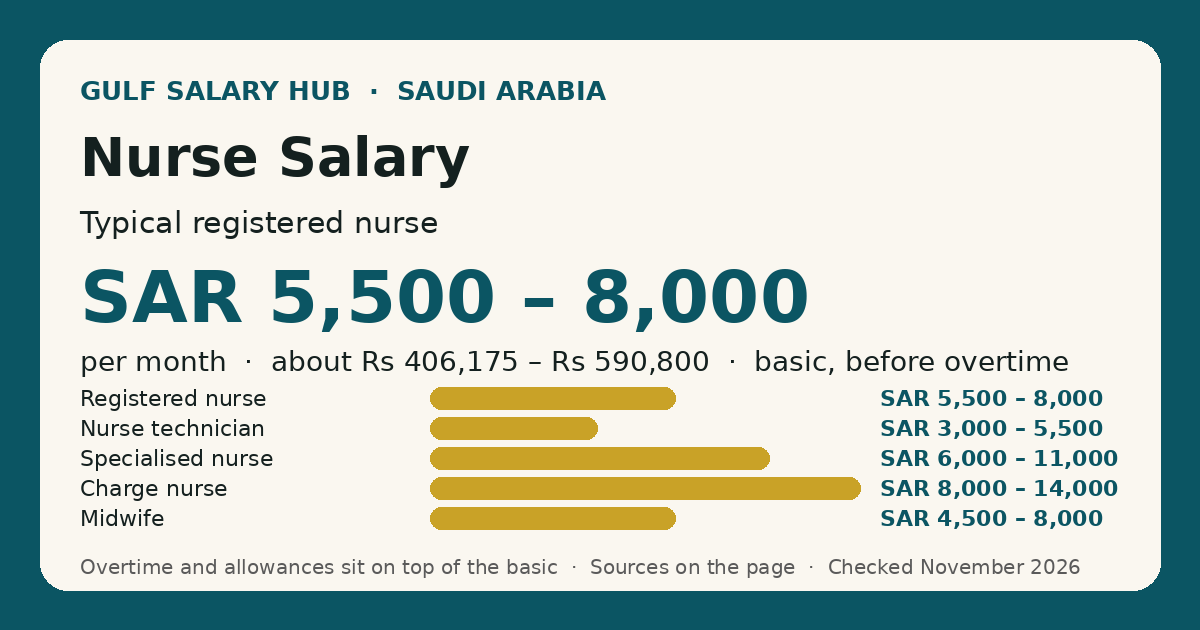
A registered nurse in Saudi Arabia typically earns SAR 5,500–8,000 per month basic — the band both current guides agree on for a registered nurse with three to five years of experience, before overtime. Nurse technicians earn SAR 3,000–5,500, specialised nurses SAR 6,000–11,000 and charge nurses SAR 8,000–14,000. An SCFHS licence is mandatory, and most packages add free housing, annual flights and medical cover.
Salary by segment — the part most websites hide
Read the eligibility note first, because it decides which of the figures below you can actually apply for. Expatriates CAN work as nurses in Saudi Arabia – both guides reviewed for this page are written for international nurses, and the Kingdom imports thousands of nurses a year from the Philippines, India, the UK, Jordan and across the Arab world. Two conditions come with that. First, an SCFHS licence is mandatory before you start work – BSN or a recognised diploma, DataFlow verification of your credentials, and the Saudi Nursing Licensing Exam (SNLE), all through the Mumaris Plus portal, with two years of post-qualification experience for Staff Nurse classification. Second, Saudization is reshaping the profession: the Ministry of Health is working toward 50% Saudi nursing staff by 2030, and general-ward posts in government hospitals are increasingly filled by Saudi nationals – so the strongest lanes for international nurses are specialty units (ICU, OR, ER, NICU, oncology, dialysis) and private hospitals. Third, a single “average salary” for this job would mislead you, because pay runs on SCFHS classification – technician, specialist, senior specialist – and on specialty, not on one flat rate. Overtime and allowances are NOT included in any figure on this page – treat them as extras on top of the basic in your contract:
| Segment | Monthly salary | Note |
|---|---|---|
| Registered nurse – the headline band | SAR 5,500 – 8,000 / month | Documented in current guides reviewed Nov 2026: this is the band both guides agree for a registered nurse – the first guide puts a registered nurse with 3 – 5 years at SAR 4,500 – 8,000 a month, and the second guide puts entry level at SAR 5,500 – 8,000. The headline band is where those ranges overlap. This is a monthly basic, before overtime and allowances |
| Nurse technician / assistant nurse | SAR 3,000 – 5,500 / month | Documented in current guides reviewed Nov 2026: the first guide puts a nurse technician / assistant nurse at SAR 3,000 – 5,500 a month. Diploma nurses are classified as Nurse Technicians by SCFHS, while degree nurses classify as Staff Nurses – the licence tier decides the band |
| Specialised nurse (ICU, ER, OR, NICU, dialysis) | SAR 6,000 – 11,000 / month | Documented in current guides reviewed Nov 2026: the first guide puts a specialised nurse at SAR 6,000 – 11,000 a month, about 25 – 40% above the general ward band. ICU, ER, OR, NICU, oncology and dialysis nurses face the most acute shortages, and specialty certifications (ACLS, PALS, CCRN) support the higher offers |
| Charge nurse / head nurse | SAR 8,000 – 14,000 / month | Documented in current guides reviewed Nov 2026: the first guide puts a charge nurse / head nurse at SAR 8,000 – 14,000 a month. Charge roles add shift leadership, staff supervision and quality documentation, usually after 8 – 12 years, and large tertiary hospitals in Riyadh and Jeddah offer the most structured senior grades |
| Midwife | SAR 4,500 – 8,000 / month | Documented in current guides reviewed Nov 2026: the first guide puts a midwife at SAR 4,500 – 8,000 a month – the same band as a general registered nurse. Midwifery is a separate SCFHS classification with its own exam pass mark |
| Entry-level listings – context only | ~SAR 4,300 – 5,000 / month | Documented in a cross-check reviewed Nov 2026: a current-listings guide puts staff nurses at around INR 1,00,000 – 1,16,000 a month, roughly SAR 4,300 – 5,000, with entry-level general-ward postings near the lower end. Listing-based figures skew low because they capture first postings, not the full ladder – it is context, not a first offer |
| Senior and advanced-practice roles – context only | SAR 9,000 – 25,000 / month | Documented in a cross-check reviewed Nov 2026: a recruitment guide puts ICU / oncology nurses at SAR 9,000 – 18,000, nurse educators at SAR 10,000 – 20,000 and nurse practitioners / clinical nurse specialists at SAR 14,000 – 25,000. These are advanced-practice and senior roles with master’s degrees or specialist certification – plan a first contract on the headline band, not on these figures |
What the job involves
Ward nursing in Saudi hospitals: assessing patients and monitoring vital signs, administering medication and IV fluids, wound care and dressings, maintaining patient records and clinical documentation, coordinating care with doctors and allied staff, infection-control practice, and structured shift handovers. Specialty units add ventilator and monitor management in ICU, dialysis machines in renal units, emergency triage in ER, and scrub / circulating duties in operating theatres. Shifts are commonly 12 hours with night and weekend rotation, and most contracts run two years with a 90-day probation.
What your total package usually includes
For nurses in Saudi Arabia, the package lines that decide the real offer are the SCFHS classification on the offer, whether housing is a room or an allowance, and how overtime and night differentials are counted – read the table with those in mind:
| Part of the package | What it usually means in practice |
|---|---|
| Housing | Shared accommodation is standard at entry level. Some employers give a housing allowance instead — a room and cash are not worth the same, so ask which one your offer includes. |
| Transport | Company transport to the site is common on project work. City jobs may give a transport allowance, or nothing at all — and if it is nothing, that cost comes out of your salary. |
| Overtime | Paid on top of basic when hours run long. Get the rate — and how the hours are counted — in writing. "Overtime available" with no rate attached means very little. |
| Medical | Employer-provided health insurance, arranged as part of the job. You should receive the insurance card — not have to chase anyone for it. |
| Air ticket | A return ticket home every 1–2 years is standard in most contracts. Check the interval, and whether it covers family (at this level, it usually covers you only). |
Count these before you judge any offer. A slightly lower salary with housing, transport and overtime paid can leave you with more in savings at month's end than a higher headline figure without them.
On a Saudi nursing offer, confirm in writing: the SCFHS classification and the basic salary for that classification, whether accommodation is a furnished room or a housing allowance, how overtime and night differentials are calculated and recorded, and whether the employer covers SCFHS registration and DataFlow verification costs – those answers are worth more than a small difference in the basic figure.
How pay is structured for nurses in Saudi Arabia
Nurses in Saudi Arabia are paid a fixed monthly basic salary in riyals, set by the SCFHS classification on the offer – technician, specialist or senior specialist – with overtime and night differentials on top, and the rates and how hours are recorded belong in the contract, because the basic, not the overtime, decides your end-of-service gratuity. Saudi Arabia levies no personal income tax, so the agreed basic is the take-home figure before any deduction the contract itself states, and there is no social insurance deduction for non-Saudi nurses. Housing is usually provided as a furnished room in a nurses’ compound, or as an allowance of roughly a quarter of basic; transport runs by hospital bus or an allowance of about 10% of basic. An annual return ticket and 30 – 45 days of paid leave are common, medical insurance is mandatory and provided, and end-of-service accrues at half a month’s wage per year for the first five years and a full month per year after. Salaries are paid through the Wage Protection System (Mudad). The employer sponsors the work visa once the SCFHS licence number is issued, and many employers cover the SCFHS registration and DataFlow verification costs. Contracts are typically two years with a 90-day probation. Because the riyal is pegged to the US dollar – one riyal is about Rs 73.85 – small riyal differences are large money at home: SAR 500 a month is about Rs 36,925, so the provided parts of the package (room and transport) deserve the same attention as the salary figure itself.
Where nurse jobs are concentrated in Saudi Arabia
Riyadh holds the most nursing work – King Faisal Specialist Hospital and Research Centre, King Abdulaziz Medical City (National Guard), Prince Sultan Military Medical City, Dr. Sulaiman Al Habib and the Ministry of Health hospital clusters. Jeddah follows with its own National Guard and specialist centres plus large private groups, and the Eastern Province (Dammam, Al Khobar, Dhahran) adds Johns Hopkins Aramco Healthcare and the oil-sector medical facilities. Makkah and Madinah intensify hiring around Hajj season, when millions of pilgrims need healthcare. The Ministry of Health alone operates more than 500 hospitals across all 13 regions, so nursing posts exist in every region – but the premium employers, the specialist units and the structured senior grades concentrate in Riyadh, Jeddah and the Eastern Province. Hiring runs year-round, with the strongest demand in critical care, emergency, perioperative and neonatal units.
How to get this job safely
1. Apply to the company directly, or go through a licensed Overseas Employment Promoter — nobody else. 2. Before you pay a single rupee, verify the agent's licence and check the job has a Permission Tracking Number (the guide below shows how). 3. Get the salary, the overtime rate and the accommodation written into the contract — a verbal promise made in an agent's office tends to disappear at the airport. 4. Never hand your original passport to an unlicensed person, and never travel for work without the Protector stamp.
Frequently asked questions
Can an expatriate work as a nurse in Saudi Arabia?
Yes. Both guides reviewed for this page are written for international nurses – the Kingdom imports thousands of nurses a year from the Philippines, India, the UK, Jordan and across the Arab world, and over 180,000 nurses work in the country with about 60% expatriates. The condition is an SCFHS licence before you start work. One honest caveat: the Ministry of Health is working toward 50% Saudi nursing staff by 2030, and general-ward posts in government hospitals are increasingly filled by Saudi nationals – so target specialty units (ICU, OR, ER, NICU, oncology, dialysis) or private hospitals, where international hiring is strongest.
What is the typical nurse salary in Saudi Arabia?
SAR 5,500–8,000 a month basic for a registered nurse with three to five years of experience – the band both current guides agree on. Nurse technicians earn SAR 3,000–5,500, specialised nurses SAR 6,000–11,000, charge nurses SAR 8,000–14,000 and midwives SAR 4,500–8,000. Overtime and allowances sit on top, and most packages include free housing or an allowance, annual flights home and medical cover.
Do I need an SCFHS licence before I apply?
You need SCFHS registration before you can start work, and you should start the application before you apply for jobs – employers need your licence number before they issue a work visa. The route is: create a Mumaris+ account, submit your degree, transcripts, home-country licence and experience proof, complete DataFlow primary-source verification (about 4–8 weeks), pass the Saudi Nursing Licensing Exam (SNLE) if your title requires it, then pay the registration fees. A BSN or recognised diploma and at least two years of post-qualification experience are needed for Staff Nurse classification, plus BLS certification (ACLS/PALS for specialty nurses).
Why do some websites say nurses earn SAR 12,000, or only SAR 4,300?
Both figures are real, and they describe different nurses. The SAR 4,300–5,000 band comes from a guide built on current entry-level listings – first postings, mostly general wards. The SAR 6,500–12,000 band for a general RN comes from a guide that blends entry, mid-level and senior pay into one range. Our headline, SAR 5,500–8,000, is the overlap both detailed guides agree for a registered nurse with three to five years of experience. Senior and specialist figures – ICU nurses to SAR 18,000, nurse practitioners to SAR 25,000 – sit on this page as context only.
Which hospitals pay nurses the most in Saudi Arabia?
Military hospitals, National Guard Health Affairs and Saudi Aramco medical facilities form the premium tier, above standard Ministry of Health levels, with better housing and schooling support – and they are selective about qualifications and specialty background. Ministry of Health hospitals are the largest employers with structured scales and solid benefits. Large private groups such as Dr. Sulaiman Al Habib pay competitively and hire faster. The hospital type matters as much as the job title when comparing offers.
What does a Saudi nursing package usually include?
The salary is tax-free – Saudi Arabia levies no personal income tax. Most contracts add free furnished housing or a housing allowance (about a quarter of basic), transport by hospital bus or an allowance of about 10% of basic, an annual return air ticket, comprehensive medical insurance, 30–45 days of paid annual leave, and end-of-service benefits under Saudi labour law. Many employers also cover SCFHS registration and DataFlow verification costs. Overtime and on-call allowances exist in most hospital contracts – get the rate in writing before you sign.