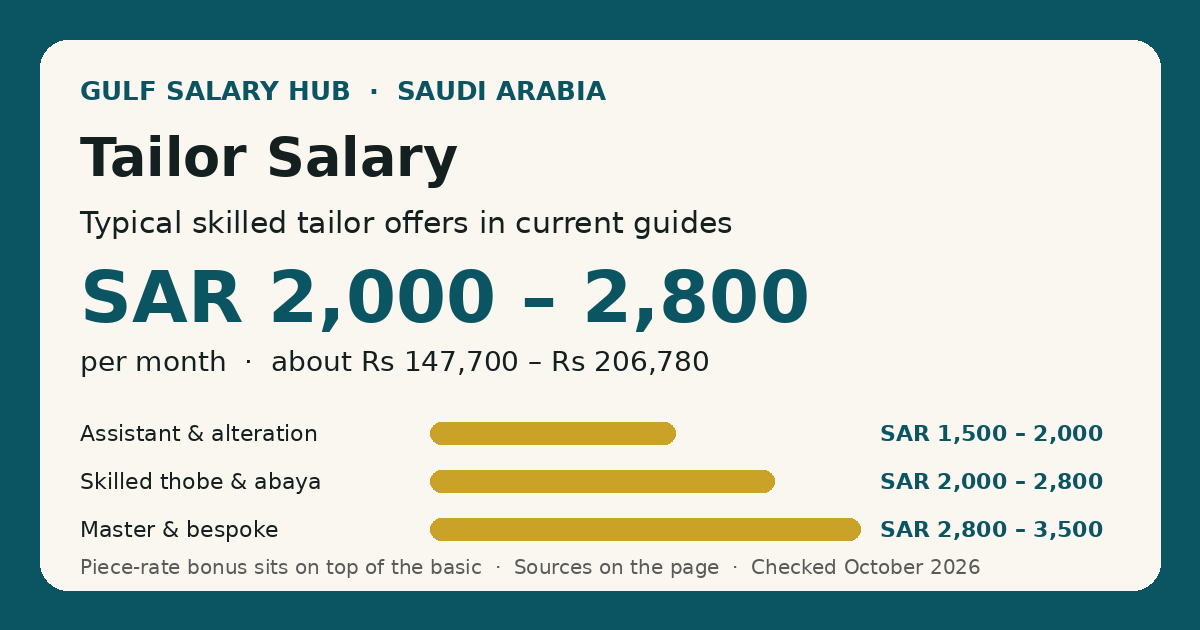
A tailor in Saudi Arabia typically earns SAR 2,000–2,800 per month as a skilled thobe and abaya tailor. Assistant and alteration tailors start at SAR 1,500–2,000, while master and bespoke tailors earn SAR 2,800–3,500. The headline band is for tailors who can cut and finish a complete garment, not for assistants.
Salary by segment — the part most websites hide
A single “average salary” for this job would mislead you, because “tailor” covers three different grades of skill. An assistant who hems and alters is not paid as a skilled tailor who measures, cuts and stitches a thobe or abaya from cloth, and neither is paid as a master tailor who cuts patterns and runs bespoke orders — the grade, not the job title, sets the pay. Piece-rate bonuses and season incentives are NOT included in any figure on this page — treat them as variable extras on top of the basic in your contract:
| Segment | Monthly salary | Note |
|---|---|---|
| Assistant and alteration tailors | SAR 1,500 – 2,000 / month | Documented in current guides reviewed Oct 2026: BOTH main guides put assistant / alteration tailors at SAR 1,500–2,000 — hemming, simple alterations, finishing and helping the skilled tailor, on single-needle and overlock machines. One guide welcomes freshers at this grade with on-the-job training in the first two weeks; both guides prefer 1–3 years of stitching or alteration experience for the grade above. This is the entry band, not skilled tailor pay |
| Skilled thobe and abaya tailors | SAR 2,000 – 2,800 / month | Documented in current guides reviewed Oct 2026: BOTH main guides put skilled thobe / abaya tailors at SAR 2,000–2,800 — the headline band. This is the working tailor: taking measurements, cutting cloth to pattern, stitching thobes, abayas and uniforms, and finishing to a standard a customer will pay for. The cross-check guide puts thobe / abaya / cutting skills toward SAR 2,000–3,000, which supports this band. Piece-rate bonuses and season incentives sit on top of the basic, never in it |
| Master and bespoke tailors | SAR 2,800 – 3,500 / month | Documented in current guides reviewed Oct 2026: BOTH main guides put master / bespoke tailors at SAR 2,800–3,500 (one guide ‘3,500+’ for bespoke work) — cutting masters and thobe specialists who run patterns, bespoke orders and fittings, and who shops trust with expensive cloth and regular customers. Above this band sit pattern makers, cutting supervisors and designers (SAR 4,000 and up in wider guides) — different jobs, kept out of the tailor bands and mentioned only in the questions below |
What the job involves
Measuring customers and marking cloth; cutting fabric to pattern for thobes, abayas, uniforms, suits and altered garments; stitching on single-needle, overlock and flatlock machines; doing alterations — hems, waists, sleeves, tapers — to the customer’s specification; adding buttons, zippers, embroidery and trim; ironing, pressing and quality-checking finished garments before they are handed over; keeping the workroom, machines and stock of thread, needles and trim in order; and dealing politely with walk-in customers at measurements and fittings. The work is indoor, seated and craft-based, and it is busiest before Ramadan, Eid and the wedding seasons — the months when overtime and piece-rate earnings rise most.
What your total package usually includes
For tailors, the package usually comes down to shared accommodation, shift meals and how piece-rate and season bonuses are counted — the table below shows what each part normally means in this trade:
| Part of the package | What it usually means in practice |
|---|---|
| Housing | Shared accommodation is standard at entry level. Some employers give a housing allowance instead — a room and cash are not worth the same, so ask which one your offer includes. |
| Transport | Company transport to the site is common on project work. City jobs may give a transport allowance, or nothing at all — and if it is nothing, that cost comes out of your salary. |
| Overtime | Paid on top of basic when hours run long. Get the rate — and how the hours are counted — in writing. "Overtime available" with no rate attached means very little. |
| Medical | Employer-provided health insurance, arranged as part of the job. You should receive the insurance card — not have to chase anyone for it. |
| Air ticket | A return ticket home every 1–2 years is standard in most contracts. Check the interval, and whether it covers family (at this level, it usually covers you only). |
Count these before you judge any offer. A slightly lower salary with housing, transport and overtime paid can leave you with more in savings at month's end than a higher headline figure without them.
On a tailor offer, confirm in writing: accommodation provided or an allowance (a shared room near the souq or mall is the norm), whether shift meals or a food allowance are included, how the piece rate is calculated and whether it is guaranteed or variable, who pays for the visa and medical, and whether the job title on the contract and work permit says tailor — a helper or general worker title at tailor pay, or the reverse, follows you to the next job.
How pay is structured for tailors
Tailors are paid a fixed monthly basic salary through the Wage Protection System, with piece-rate bonuses on top in many shops — paid per garment or per alteration completed — plus overtime at basic hourly rate plus 50 percent when hours run long and season incentives before Ramadan, Eid and weddings. Get every bonus rate into the contract, because a busy festival month is not the salary. The figures on this page are basic only: accommodation and meals are normally separate, and a lower basic with both provided can be worth more than a higher basic without them. Judge every offer on its written basic first — the basic (not the bonus total) is what the end-of-service gratuity is calculated on.
Where tailor jobs are concentrated
Riyadh is the biggest single market — thobe shops in the souqs and malls, uniform companies and garment workshops across the capital. Jeddah follows with its own tailoring souqs and Red Sea resort and hotel uniform work, and Dammam, Khobar and Jubail add industrial and company uniform workshops in the Eastern Province. Makkah and Madinah hold pilgrim-season tailoring demand — new thobes and abayas before Ramadan and Hajj — plus year-round shops serving residents. Bespoke menswear boutiques cluster in the big malls; ready-made and uniform factories hire in batches for large orders and before each festival season.
How to get this job safely
1. Apply to the company directly, or go through a licensed Overseas Employment Promoter — nobody else. 2. Before you pay a single rupee, verify the agent's licence and check the job has a Permission Tracking Number (the guide below shows how). 3. Get the salary, the overtime rate and the accommodation written into the contract — a verbal promise made in an agent's office tends to disappear at the airport. 4. Never hand your original passport to an unlicensed person, and never travel for work without the Protector stamp.
Frequently asked questions
Why do some websites say Saudi tailors earn SAR 5,000 or more a month?
Those figures describe the grades above tailoring, or a busy month, not a skilled tailor’s basic. Wider guides reviewed for this page put pattern makers at SAR 4,000–7,000, tailoring supervisors at SAR 5,000–9,000 and fashion designers higher still — jobs that design, pattern-cut for production or manage a workshop, not jobs that stitch garments. A master tailor in a busy Ramadan or Eid month can also take home more than the basic once piece-rate bonuses are added — but that is a season, not a salary. The two detailed guides put ordinary tailoring at SAR 1,500–2,000 for assistants, SAR 2,000–2,800 for skilled thobe and abaya tailors, and SAR 2,800–3,500 for masters. Plan your first contract on the band for the grade you are actually hired at.
Is tailoring open to expatriates, or is it reserved for Saudi nationals?
It is open to expatriates. Both guides reviewed for this page describe year-round recruitment of overseas tailors — Indian tailors are named as prized for precise measuring, cutting and finishing — on employer-sponsored work visas through thobe and abaya shops, uniform companies and garment units in Riyadh, Jeddah and Dammam. No Saudization reservation for tailors as such was found in the sources reviewed. Never pay anyone for a visa: the shop or factory applies for the permit in your name and pays the recruitment cost.
Do I need a certificate to work as a tailor in Saudi Arabia?
No formal education is required, and there is no tailoring licence you buy privately. What shops actually test is skill: both guides describe a short trade test at hiring where you cut, stitch and finish a sample, and one guide states plainly that honest work in that test and real experience matter far more than any certificate an agent tries to sell you. An ITI certificate in cutting and sewing helps for skilled roles, and 1–3 years of stitching or alteration experience is preferred — but the sample you sew is what gets you hired.
Is the piece-rate bonus included in these salary figures?
No — deliberately. Both guides list piece-rate bonuses, season incentives and overtime on top of the basic, and one guide warns to confirm the piece-rate and bonus policy in writing before signing. A piece rate can lift a fast tailor’s month well above the basic in a busy season, and leave a slow month at the basic — so judge an offer on its written basic first, get the piece-rate terms (per garment, per alteration, and how it is counted) in the contract, and treat bonuses as extra, never as pay you can plan around.
How can I earn more as a tailor in Saudi Arabia?
Specialise in the garments Saudi customers actually order made-to-measure: thobe and abaya work pays the skilled premium, and cutting and pattern skill is what moves a tailor into the master band. Both guides agree on the ladder: assistant → skilled tailor → master / cutting master, then floor in-charge or shop supervisor for tailors who can run orders, brief a team and keep quality consistent. Speed with clean finishing is what shops hire and promote on — a tailor whose work needs no rework gets the better orders — and basic Arabic for fittings, plus embroidery or machine-embroidery skill, widens the shops that will take you.